
When the Firewall Falls
What was once the world’s most welcoming country for refugees has become one of the strictest — an about face that could set the example for other democracies.


Were one to walk into the neighborhood of Rosengård in Malmö, the third largest Swedish city, one might feel one had wandered into an ex-Eastern Bloc country — at least judging from the architecture alone. If one were to judge from the ethnic makeup of its inhabitants however, the conclusion reached would be quite different.
One of the hallmark political programs in the heyday of “Socialist” dominance in Sweden was the so-called Million Program. It was a massive housing program implemented between 1965 and 1974, encompassing the building of one million new housing units.
This goal was accomplished, with Rosengård being one of the archetypal examples. But, as with many sweeping social-engineering projects, it did not work as intended. The issue was that many Swedes did not really want to live in the newly built housing. Sweden had only about 6 million people at the time, and since it is a vast country, it had low population density. Swedes just preferred to live in houses and not in the large apartment complexes that were basically the same as commie blocks in the Eastern Bloc countries — once mortgages became cheaper than renting one of these flats, anyone with the means simply left.
The estates were never completely empty however. Working-class Swedes were the first to occupy them. When those who could afford to move out, did, increasingly only the lowest-income segment of Swedish society remained.
The Humanitarian Superpower
This dynamic coincided with another defining trait of the era: the reorientation of immigration policy toward refugees and the persecuted, which created the image of Sweden as a so-called humanitarian superpower.
Under the socialist prime minister Olof Palme, in 1975 the Swedish parliament voted unanimously for a new immigrant and minority policy that explicitly rejected the previous approach of assimilation and ethnocultural homogeneity in favor of state-sponsored multiculturalism.
Since then, and until relatively recent, Sweden has been wide open to refugees from basically everywhere: people fleeing communist persecution in Poland, Greece’s Regime of the Colonels, Augusto Pinochet’s regime in Chile, the Iranian revolution of 1979, the Bosnian war, Somalia, Iraq, Algeria, Afghanistan, and in 2015, Syria.
Throughout this period, there was always somewhere to house the refugees, since the vacancies left behind in these estates were increasingly allotted to new arrivals. The result was an ever more pronounced segregation of the native population from the immigrant communities.
In many parts of Sweden, even in some of its major metropolitan areas, one would not guess that Sweden is a high-immigration country. However, this fact only helped perpetuate the illusion of a harmonious society while trouble had been brewing all along.
In the past decade or so, roughly since the migration crisis of 2015, things escalated in Sweden to the point where the long-held elite consensus around refugee-based immigration became untenable.

Sweden accepted roughly 160,000 asylum seekers in 2015 alone — about 1,600 per 100,000 inhabitants, by far the largest figure in Europe and, by most measures, the world on a per capita basis — with Syrians and Afghans making up the largest groups.
The problems stemming from the Swedish state overstretching itself became impossible to ignore. A number of issues were of a more or less logistical nature — a lack of accommodation facilities, teachers, and interpreters, which were already causing strain before the new influx, but which had now reached critical dimensions.
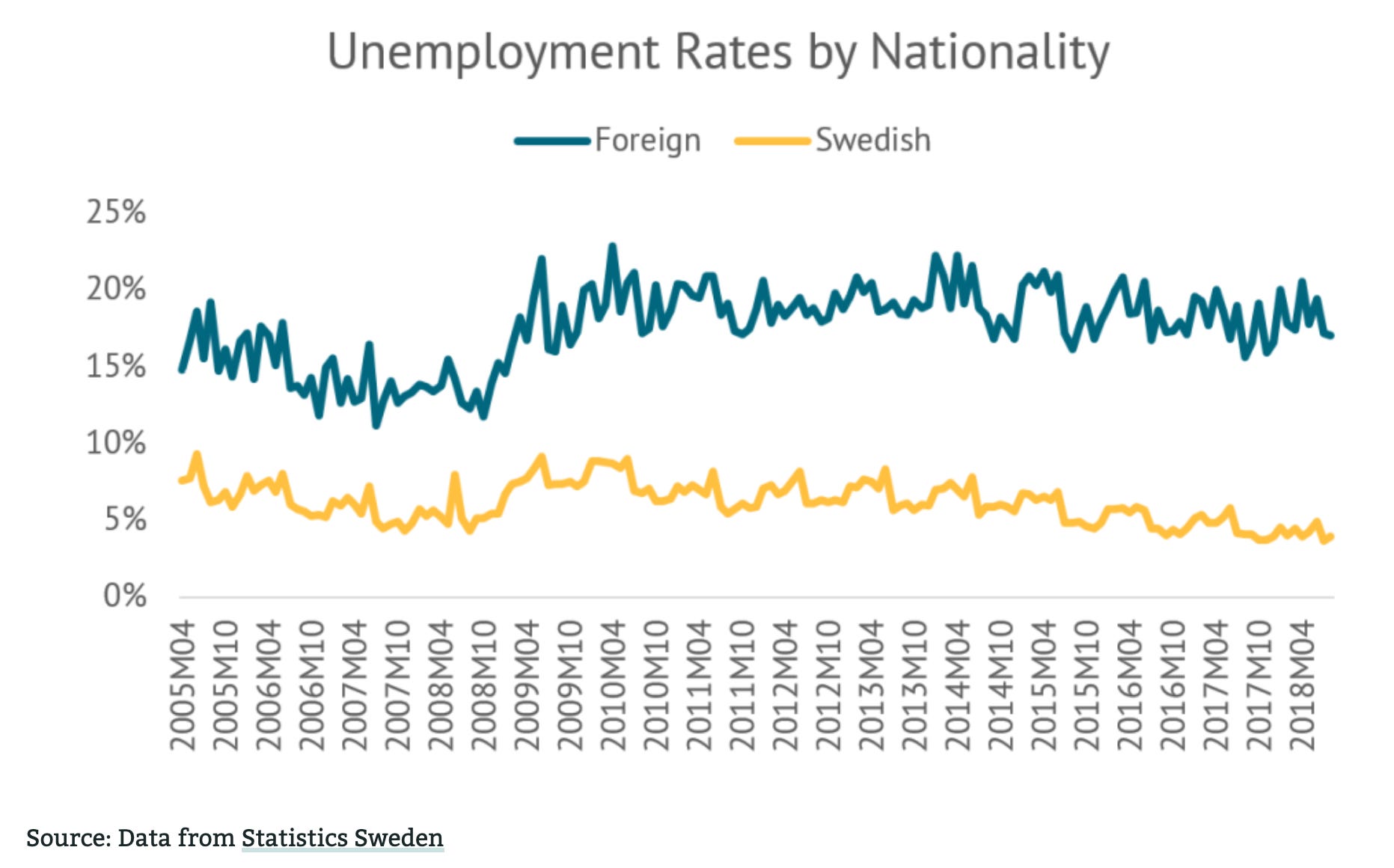
Yet the problems went much deeper than that. Even though the Swedish state never hesitated to generously fund integrationist policies, the results never came: of the refugees who arrived in 1997–1999, only about 30% were employed after two years, with just 65% after ten, while the average for the native-born population stood around 83%. In 2014, Sweden had the largest gap between the figures for natives and immigrants in the OECD.
Part of this failure stemmed from the structural shifts taking place in the Swedish economy, which was increasingly transforming from an industrial to a post-industrial service economy driven by technology and automation. The job market for low-skilled workers without language skills was shrinking, as less than 5% of jobs in Sweden required only primary education or less.
The concentration of migrants in the neighborhoods described above led to the creation of so-called parallel societies — neighborhoods with high unemployment, schools where a large proportion of the pupils can’t speak Swedish, and a lot of gang violence.
In 2023, Sweden experienced 53 fatal shootings, which catapulted it from a country with one of the lowest rates of such incidents to that of the highest in Europe. An estimated 30,000 people may be connected to criminal gangs, a substantial number of which are minors, recruited to take advantage of the country’s lenient laws for juveniles.
In many ways, Sweden has become a cautionary tale of a European country failing to get a grip on immigration. In a televised address to the nation in September 2023, Prime Minister Ulf Kristersson said: “Irresponsible immigration policy and failed integration have brought us to this point.”
That same day, from the opposition benches, Social Democratic leader Magdalena Andersson expressed shock over his choice of words, even as her party called on the government to change the law to let the military help police tackle the gangs: “This is not Sweden, this is not how Sweden is supposed to be,” she said.
A strong political reaction was becoming inevitable.
The Cordon Falls
For a long time, the political reaction to growing migration-related tensions looked like the archetypal European cordon sanitaire tale. In Sweden, the object of this cordon sanitaire — the term for parties deemed by the mainstream too extremist to be considered as part of a political coalition — was the Sweden Democrats.
Founded in 1988, the party’s roots were genuinely far-right, as it had connections with neo-Nazi circles. For a long time it was completely ignored by the rest of the Swedish political class, which was also not that hard to do, since in the first two decades of its existence the party did not garner strong electoral results.
The whole subject of immigration was treated as taboo, with those raising its negatives being predictably accused of racism. Furthermore, it being avoided was justified as not giving the Sweden Democrats “ammo” for potential electoral gains.
Yet, as is almost a rule in such cases, it had the opposite effect. The party came to be seen as one unafraid to tell it like it is, while the elites were seen as sweeping the issue under the rug.
In 2010, the Sweden Democrats got enough votes to enter parliament, and in 2018 they scored 17.5%, becoming the third-largest party. As the mainstream parties, including the Social Democrats, were forced to acknowledge the failures of Sweden’s immigration policy, the criticism of the Sweden Democrats — who had also systematically worked to break with their extremist roots —for pointing those failures out no longer made much sense.
In 2019, Christian Democrat leader Ebba Busch announced her willingness to negotiate with the SD, as did Moderate leader Ulf Kristersson. The culmination came with the Tidö Agreement after the 2022 election. Four leaders of parties on the right conferred at Tidö Castle and signed a 62-page contract that established the current government and a fundamental shift in crime and migration policy.
Germany at a Standstill

The Germans still call it the ‘Grand Coalition’. And yet the government formed by the CDU/CSU and SPD commands a mere 328 of 630 seats in the Bundestag. The era in which the former ‘people’s parties’ dominated the Federal Republic is drawing to a close alongside the passing of the Baby Boomer generation. Only among older citizens do the governing parties still win substantial vote shares. The AfD – which the current Federal Chancellor Friedrich Merz had pledged to ‘halve’ – stands at 27 per cent in the polls. The chancellor’s own parties, the CDU and CSU, together reach a mere 25 per cent.
The SD won 20.5% and, as the second-largest party, became the key guarantor of the government’s majority — for the first time after eight years of Social Democratic-led rule. One barrier however remained: the SD negotiated policy but were not formally part of the cabinet.
The last remnant of the cordon was done away with this year. Ahead of the 2026 election, even the Liberals dropped all their “red lines” on cooperating with the SD, becoming the last party in the Tidö coalition to end the cordon entirely. Kristersson declared that if the right-wing bloc wins a majority, he will bring the SD into the cabinet and give them ministerial posts.
This political realignment, once it came, brought real and sweeping changes.
Since 2022, the Kristersson government has advanced some forty measures under a single doctrine: that Swedish asylum law should not exceed the EU minimum, and that the country should shift from a destination for asylum seekers to one for skilled labourers.
The permanent residence which was once granted to asylum seekers has given way to temporary permits, and a 2025 proposal, slated to take effect in 2027, would go further still, retroactively stripping permanent status already granted. The change could affect up to 185,000 people, though for now it remains only a proposal.
Other measures run the same way: rejected asylum seekers who had found jobs can no longer stay on and switch to a work permit, as they once could, but must leave and apply from abroad; and a deportation order now remains in force until the person actually departs, closing off the former tactic of simply waiting out a fixed deadline inside the country. All the while, Sweden has made itself more attractive to skilled workers.
The effect is already measurable: asylum immigration is at its lowest since 1985, and net migration has turned negative for the first time in roughly 50 years. The winds of change have indeed reached the shores of Scandinavia.
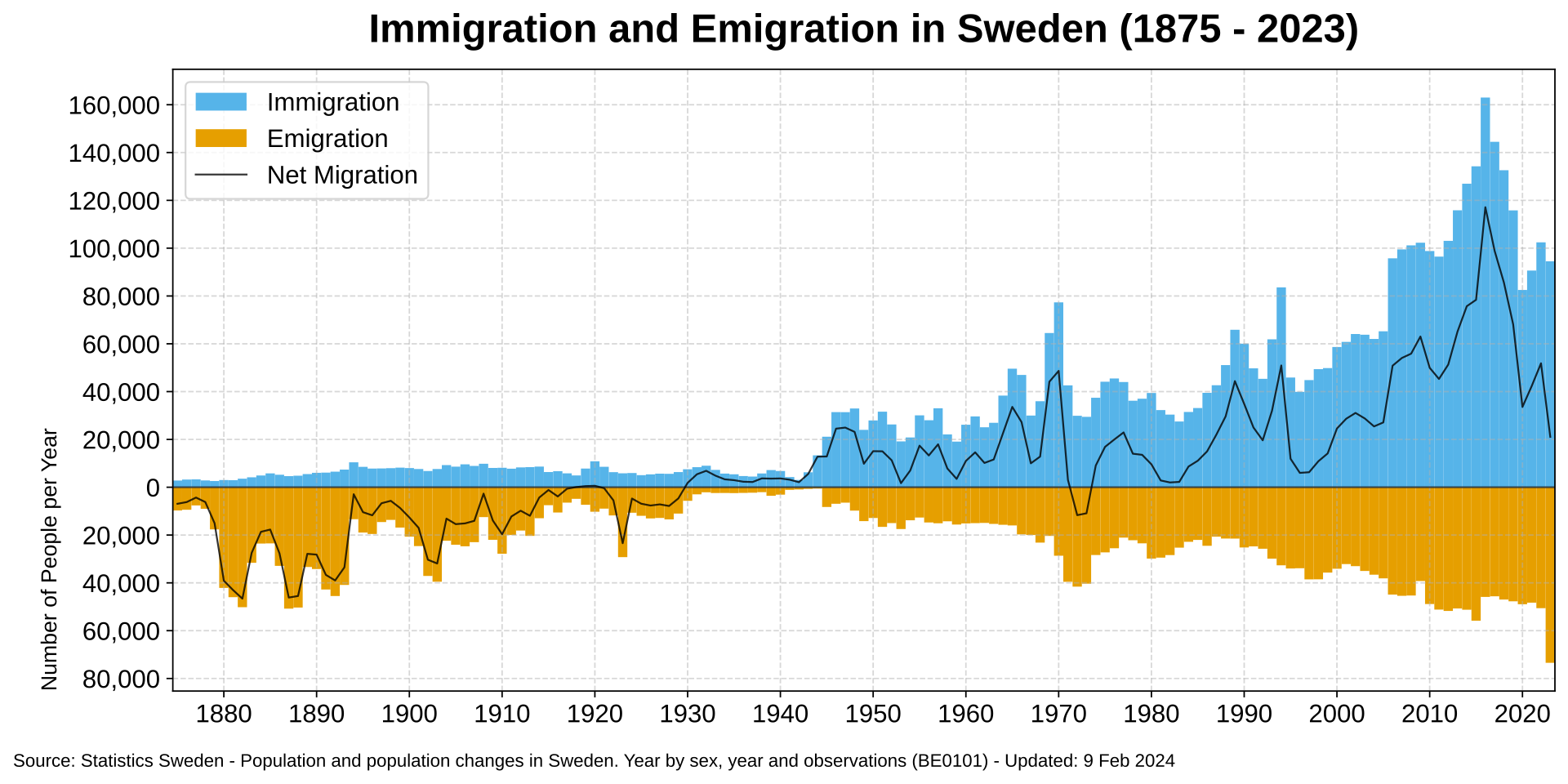
Source - Marcin Floryan, CC BY 4.0 <https://creativecommons.org/licenses/by/4.0>, via Wikimedia Commons
Why Sweden?
Yet the question we really need to ask is what differentiates Sweden from other European countries where the public is similarly frustrated over migration, but where political elites seem far less willing or able to respond.
In Germany, although there have been some policy changes, the German version of the cordon sanitaire — the so-called Brandmauer, or “firewall,” surrounding the AfD — remains far more rigid, and adherence to it sometimes reaches comical proportions. In May 2026, the Greens in the Saxony state parliament submitted a motion to support small slaughterhouses by cutting state fees, expecting it to fail. Instead it passed, 55 to 52 — carried by votes from the AfD and the left-populist BSW. The Greens had won on substance but symbolically breached their own firewall, and their reaction drew mockery: rather than welcoming the passage of their own motion, chairwoman Franziska Schubert declared that a majority achieved with AfD votes “pains us deeply.”
In the United Kingdom, the Conservative Party won a historic majority in the 2019 general election partly on anti-immigration sentiment, as traditional Labour voters in more working-class parts of the country defected to the Conservatives — only for that same party to then preside over a massive wave of non-European immigration that added further fuel to the socio-political fire.
There are several points worth considering. While Swedes are not known for performative, flag-waving nationalism — which many would find at odds with the tradition of Swedish restraint — they are nonetheless deeply proud of their country, in a more low-key manner.
And there is a lot to be proud of. Sweden is an extraordinarily successful nation. In economic terms, the roster of world-renowned companies (IKEA, Volvo, Saab, Spotify) for a country of only ten million people is remarkable.
Sweden remains the only country of its size to design and develop its own modern fighter jet — something even Israel does not do. Beyond economics, Sweden is also one of the most influential cultural exporters outside the English-speaking world, leaving an outsized footprint in pop music — both through its performers (ABBA, Roxette, Ace of Base, Avicii) and its songwriters.
The gradual transformation of the country’s image — from a byword for success into a synonym for immigration-linked crime and disorder — surely rubbed Swedes entirely the wrong way, and all the more so given the contrast with Denmark next door.
Denmark is among the most restrictive Western European states on immigration, its approach shaped, among other things, by direct efforts to avoid the outcomes Danes observed in Sweden, its culturally similar Nordic neighbour.
The two nations frequently engage in friendly games of one-upmanship. Being seen as the cautionary tale, especially by Denmark, must itself have played a role in convincing Sweden to change its policies, with Denmark’s standing as a viable alternative.

.svg)
Moreover, Sweden’s modern history simply lacks the attributes that often feature prominently in immigration debates, where calls for more restrictive policies are countered by appeals to guilt over past crimes, whether real or alleged.
Sweden had no major colonial empire like the British, French, or Dutch did, and played no direct role in the crimes of the Second World War — beyond supplying Nazi Germany with raw materials as a neutral country.
If anything, the Swedish relationship to the “never again” narrative surrounding the Holocaust is fundamentally different from Germany’s, because Sweden played one of the most significant roles among neutral states in the rescue of Jews, from Raoul Wallenberg’s protection of tens of thousands of Hungarian Jews in Budapest to the ferrying of almost the entire Danish Jewish population to safety across the Øresund in 1943.
One of the remarkable moments in the normalisation of the SD captures this tension. During the 2018 campaign, Moderate leader Ulf Kristersson visited Holocaust survivor Hédi Fried who, by the latter’s account, promised her he would “never, never, never” cooperate with the far-right Sweden Democrats. Kristersson disputes her interpretation, saying the pledge referred to his 2018 coalition strategy rather than an irrevocable personal vow.
The culture of the Nordic countries has a certain inclination to collectivism, which without doubt helped to perpetuate the consensus surrounding immigration policy even when its downsides were patently obvious. Yet it is also worth noting that Sweden has repeatedly proven able to reinvent itself. After the banking crisis of 1990–94, Sweden overhauled its economic model through a series of largely cross-party reforms — a sweeping tax reform, a landmark self-stabilising pension system, market deregulation, and a strict fiscal framework — trading its most punitive high-tax, heavily regulated features for a leaner “market welfare state.”
These changes are broadly seen as one of the essential pillars of Sweden’s contemporary tech-economy success, placing it among the best performers in Europe: Stockholm itself produces more unicorns per capita than either New York or London.
Hopefully, the immigration reforms of recent years will prove to be another successful example of Sweden’s knack for reinvention. The country’s struggles with past mistakes are by no means over, but the outlook is significantly better than it was just a few years ago.
 | A guest post by
|
The stark reality that so many people cannot accept is that the “racism” and “bigotry” of earlier times was strongly grounded in unfortunate but very real differences among human groups, and the cultures they produce. This in no way means that Europeans should be cruel to the teeming masses of the dysfunctional third world (I.e., ending slavery was a good thing — though not something the third world itself would ever have contemplated). It does mean that mass immigration from Africa and Muslim countries will inevitably destroy the host culture (the UK is likely beyond hope at this point). Individuals from these places can and do assimilate and adapt, but beyond a critical mass this becomes impossible and third world conditions begin to metastasize (e.g., the outrageous levels of pure theft and corruption among Somalis in Minnesota).
One of the reasons I think for the change of course on this topic in Sweden is the nature of the negative impacts. Shootings and grenade attacks are just very loud and visible, and it's very difficult to make the case that they're not happening or would have been happening anyway. Some of the more abstract and diffuse arguments I think play out more similarly to other European countries, but fundamentally the gang violence problem got out of control and demanded a response in a way that I don't think has clear cut parallels elsewhere.