
Poland's $32 Billion Bet on the Future:
Poland’s vast new airport is a bet against Europe’s much-prophesied age of doom. By Kaiser Bauch.


The year is 1990, and the air in Warsaw is full — apart from a good deal of pollution from coal being burned — of hope for a better future.
The long, dark period of Soviet dominance over Poland has finally ended, and with it the economically disastrous inefficiency of communist central planning. For 300 million German marks, the German company Hochtief leads the construction of a new terminal at Warsaw-Okęcie airport, later renamed Warsaw Chopin Airport.
The new terminal opened on 1 July 1992 and travellers returning from Athens, Bangkok, Dubai, and New York were among the first to use it. In 1993 it handled nearly 2.2 million travellers — a success for Poland’s busiest airport. That same year, Germany’s busiest airport, in Frankfurt, handled 32.5 million passengers, almost fifteen times more than the new Warsaw terminal.
Poland, though free again, was still an impoverished country in the early 1990s, and one of the poorest in Europe. Air travel was simply unaffordable to most Poles. To illustrate the level of poverty there, GDP per capita in purchasing-power-parity terms was over three times higher in Germany than in Poland.
At the time, Warsaw’s skyline was dominated by a single tall building, the controversial Stalinist Palace of Culture and Science, which was built in the 1950s. Meanwhile, Frankfurt was already the high-rise capital of Germany, its banking district sprouting an ever-growing cluster of skyscrapers that marked it as the country’s financial centre.
Jump to 2025, and it is a different picture. Warsaw’s skyline, crowded with skyscrapers with more still under construction, is one of the most striking in Europe — an instant reminder that Poland has left its past firmly behind.
Polish GDP per capita in PPP terms now stands at around 70% of Germany’s and is getting closer to Germany’s figure year by year. Chopin Airport handled 24 million passengers in 2025, eleven times more than in 1993, while Frankfurt handled some 63 million. The ratio had changed from 15:1 to less than 3:1.
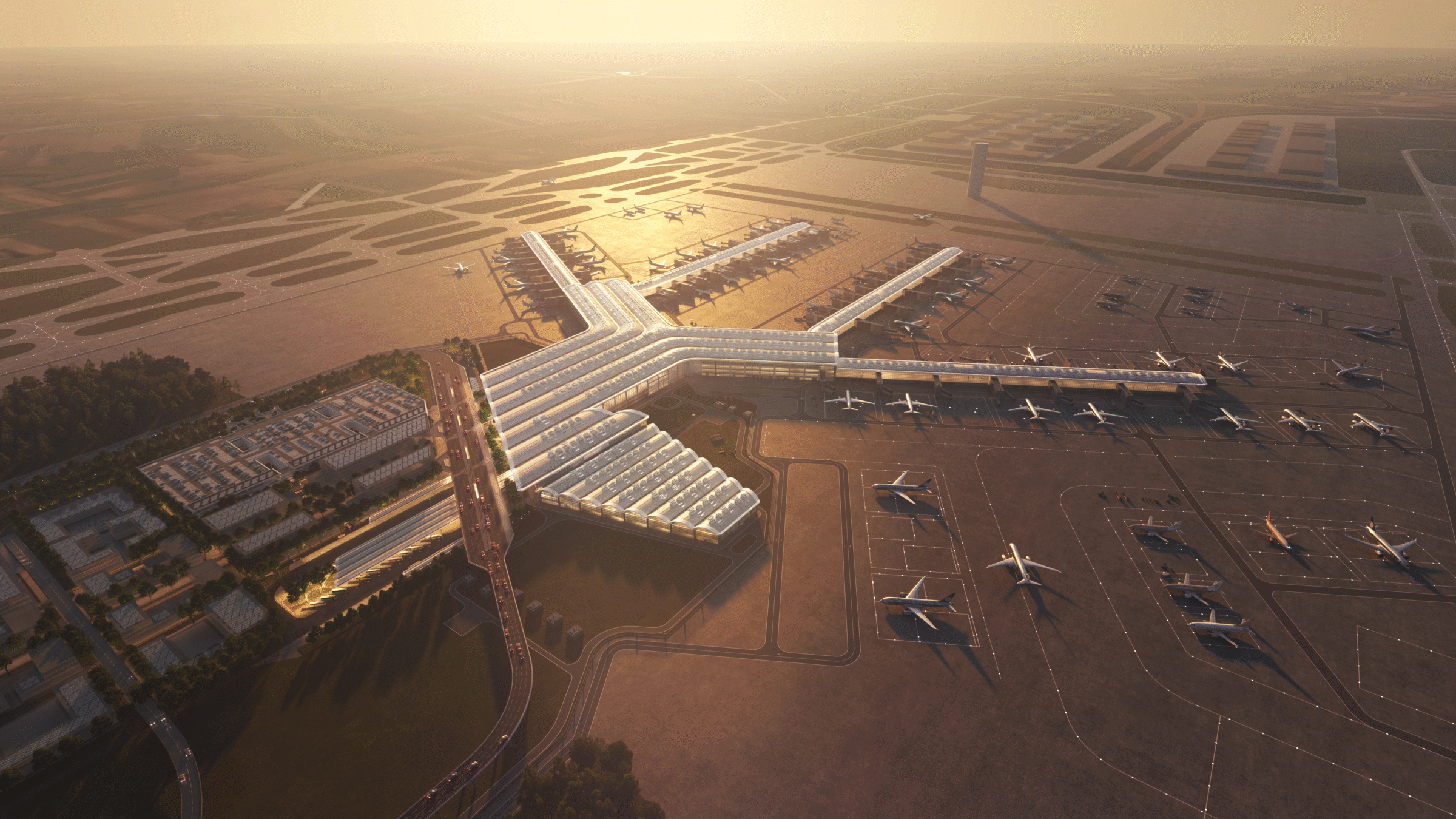
Yet Chopin’s days as the busiest airport in Poland — and in all of post-communist Europe, save Moscow’s — are likely numbered. About 40 km west of Warsaw, near the village of Baranów, work has begun on one of the largest construction projects in Europe: a vast, modern new airport is being built, which would serve as the central piece of the emerging Port Polska.

Port Polska is a strategic infrastructure programme run by the Polish state company Centralny Port Komunikacyjny, which intends to build an integrated transport system — combining air, rail, and road — around three linked components.
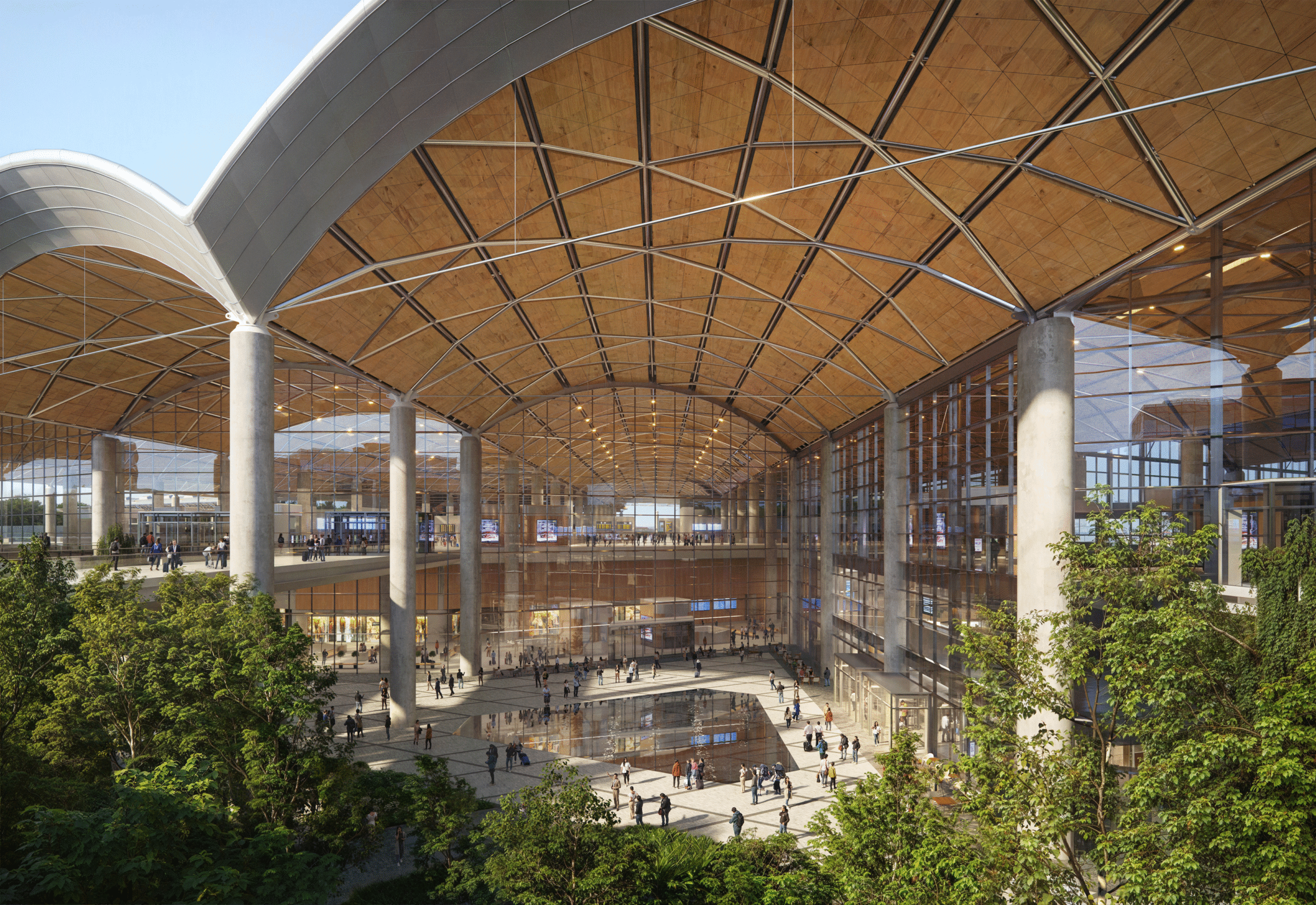
Its centrepiece is the aforementioned brand-new airport hub between Warsaw and Łódź. Designed to handle 34–44 million passengers a year when it opens in 2032, it is likely to replace Warsaw Chopin Airport, which is constrained by its location in the inner city.
The new airport will anchor LOT Polish Airlines’ network, is expected to handle up to 300,000 tonnes of cargo a year, and is intended to also handle military traffic, helping EU and NATO readiness.
The terminal is to be integrated directly with the main high-speed-rail station, the gateway to the project’s second pillar: a new 480 km, Y-shaped high-speed line linking Warsaw, Łódź, Poznań, and Wrocław, with trains running at up to 320 km/h making it possible to reach the country’s largest cities in under 100 minutes.
The Warsaw–airport–Łódź section is due to be completed by 2032 and the full line by 2035. The third pillar is the surrounding development — an “Airport City” of offices, hotels, retail shops, R&D facilities, and a “Cargo City” logistics zone. In all, the programme is expected to cost around $32.5 billion.
Bare-Knuckle Politics
As is the case with almost everything in Polish politics, the project has long been a hot-button issue, part of the ongoing culture war rattling Polish politics and society. It was approved in 2017 as a flagship of the conservative Law and Justice government, with a grand vision of processing up to 100 million passengers a year. The reactions to it laid bare the deep divisions between different segments of Polish society, as each imagines their country’s future and its role in Europe differently.
Critics dismissed it as PiS megalomania — a project sure to swallow vast sums, spent in dubious ways, largely to soothe Polish nationalists’ inferiority complex towards the West. “I don’t have a complex towards the Germans or the French, so I don’t have to prove every day that I’ll have a bigger airport [than them],” Donald Tusk once quipped. The conservatives, meanwhile, countered that opposition to the project really stemmed from it being inconvenient to Germany — as it would compete with Berlin’s new airport — tying into a long-held belief on the Polish right that Donald Tusk serves German interests instead of Polish ones.
After PiS lost the October 2023 election, Tusk’s new government nearly killed the project over excessive costs, only to reverse course slowly over the following years, nudged along by Poland’s leading business figures. In the end — after its scope having been reduced and much squabbling — the project survived, resurfacing at the end of 2025, but rebranded as Port Polska.
That the project will go ahead at all illustrates a fascinating duality in Polish politics and society. Especially since 2015, the game of politics in Poland has been played with the gloves off. In stark contrast to the country’s image as a staggering economic success, Polish politics is marked by dysfunction that would not be out of place in a banana republic: rival factions selectively ignore the rulings of legal authorities, the country’s deadlock due to it having a conservative president and a liberal government has left Poland without an ambassador in nearly fifty countries ( the United States among them ), and politics is viewed as warfare as a series of do-or-die, once-in-a-lifetime battles are being waged over the country’s future.
Poland is a country still deciding on its role in the Europe of the 21st century. One strong current of Polish thinking, prevalent on the liberal side of the spectrum, essentially wants Poland to be just “another European country” — prosperous, liberal, vaguely social-democratic, and firmly integrated into the European Union. After centuries spent on the periphery and subject to the ambitions of greater powers around it, this seems to many like a dream scenario.
Yet many on the conservative and nationalist side see it not only as a contradiction of Poland’s conservative Catholic culture, but above all as surrendering its treasured national sovereignty once again — this time to an allegedly Berlin-run European superstate — and would prefer Poland to stand as a European power in its own right.
The liberal Poles, quite correctly, see that without European integration — which would give it access to markets, cohesion funds, and foreign investment — Poland’s economic rise, a prerequisite for Polish power and prestige, would be far less potent.
They tend to view anti-European and anti-German sentiment among the nationalists as an embarrassing belittling of the very things that drove the country’s success. The conservatives, on the other hand, often emphasise that the Europe Poland once looked up to may no longer exist; becoming just “another European country” now, decades later, thus has many, far less desirable, implications.
Germany at a Standstill

The Germans still call it the ‘Grand Coalition’. And yet the government formed by the CDU/CSU and SPD commands a mere 328 of 630 seats in the Bundestag. The era in which the former ‘people’s parties’ dominated the Federal Republic is drawing to a close alongside the passing of the Baby Boomer generation. Only among older citizens do the governing parties still win substantial vote shares. The AfD – which the current Federal Chancellor Friedrich Merz had pledged to ‘halve’ – stands at 27 per cent in the polls. The chancellor’s own parties, the CDU and CSU, together reach a mere 25 per cent.
Yet even amid their never-ending bickering and accusations, Poland’s political leadership seem able to stay the course regarding the essential pillars the nation’s interests rely on: the need for military spending, the infrastructure buildup within Poland while connecting it to the post-communist countries, a tough approach to illegal migration, and the airport project. The Polish economy, for its part, does not seem to be shaken by the political turbulence.
Few things in this life seem certain, but alongside death and taxes, the fact that Poland will grow by at least 3% every year is up there. It is as if the dysfunction and chaos of its political life were just a side effect of the restless dynamism that drives the country forward. In the coexistence of massive social polarisation and an often dysfunctional political system with undeniable social and economic dynamism, Poland somewhat resembles the United States.
Much has been written about the Polish economic miracle, and much, too, about its potential pitfalls. Poland has one of the fastest-ageing populations in the world and is losing about 150,000 people a year due to low fertility. The growth of recent years has been underpinned by a great deal of debt: Polish governments have run massive budget deficits roughly since the start of the war in Ukraine, often justified by the need for military spending. Yet large portions of it have also gone towards social spending to prop up consumption. And unlike other of the world’s growth champions of recent decades, such as Korea or Taiwan, Poland has so far been unable to turn itself into a heavyweight when it comes to innovations in tech. Yet those very pitfalls are precisely why the new Polish airport project is an admirable undertaking: it is a project built on optimism about the future.
A Leap of Faith
We live in an age of widespread doomerism, with a catastrophe seeming to lurk around every corner. Some believe that climate change will decimate the ecosystem, and that the last thing we should be thinking about is CO2-heavy air travel and economic growth as such. According to others, it is an ageing population that will put a hard stop to any growth, so we ought likewise to be preparing to scale our societies down rather than up. Geopolitical tensions, too — from Russian drones and rockets to spiraling fuel prices driven by instability in the Middle East — are not going anywhere. And let’s not even start on the mayhem that AI might unleash.
And then there is this Polish project, which in effect declares: we believe we will keep getting richer, and that the whole region — the Baltic states, the Czech Republic, Slovakia, but also western Ukraine and, who knows, maybe even Belarus — will grow wealthy and relevant enough to support one of the largest airports in Europe. And, perhaps one day, even one of the largest in the world.
An airport which has passengers flying not just to Málaga or Rome on a Ryanair weekend break, but to Singapore, Beijing, Tokyo, or Los Angeles; destinations that until now have always meant changing planes at the great Western European hubs (Paris, London, Frankfurt or Amsterdam), which are built to handle long-distance traffic.
Of course, it might fail horribly. So far, it exists only on paper. The construction — especially the high-speed rail links essential to its intended functioning — could run years over schedule, with costs potentially spiralling out of control. Poland has proved that it can build large infrastructure on time and below budget — such as the remarkable expansion of its motorway network over the past twenty years, from roughly 600 to over 5,000 km, or the construction of several new football stadiums for the Euro 2012 tournament — but its railway development has been rather less stellar; high-speed rail is something Poland has no former experience with, so the potential for setbacks is real.
Some question the project’s fundamental premise: it stakes everything on building a great hub to capture east–west transfer traffic — yet that very traffic is already largely monopolised by Istanbul and Dubai, and Poland’s state carrier, LOT, is nowhere near the largest airline in Europe. Of course, the whole region might already be at its economic apex, with nothing but a long way down ahead.
Yet every great project demands a leap of faith, and investments on this scale can not only anticipate future growth but help to create it. Former Polish president Andrzej Duda, trying to persuade the Tusk government not to cancel the project back in 2024, said: “Today we need to implement large transport, trade and tourism investments so that we can travel from Poland to the whole world, so that we do not have to fly to Frankfurt, London, Paris, or Amsterdam to change to a bigger plane and fly to another continent.”
The statement lends weight to the argument made by the project’s critics: that it is motivated, in part, by an inferiority complex towards Western Europe. Yet is that necessarily a bad thing?
If a sense of inferiority can be transformed into a motivation to do better, then it is a productive way to channel such feelings. Many of history’s great achievements would never have happened without the desire to match someone who is more successful. I, for one, am looking forward to flying somewhere out of Port Polska in a few years’ time.

 | A guest post by
|
that project has a good chance of being a symbol of polish economic demise