

by David Engels
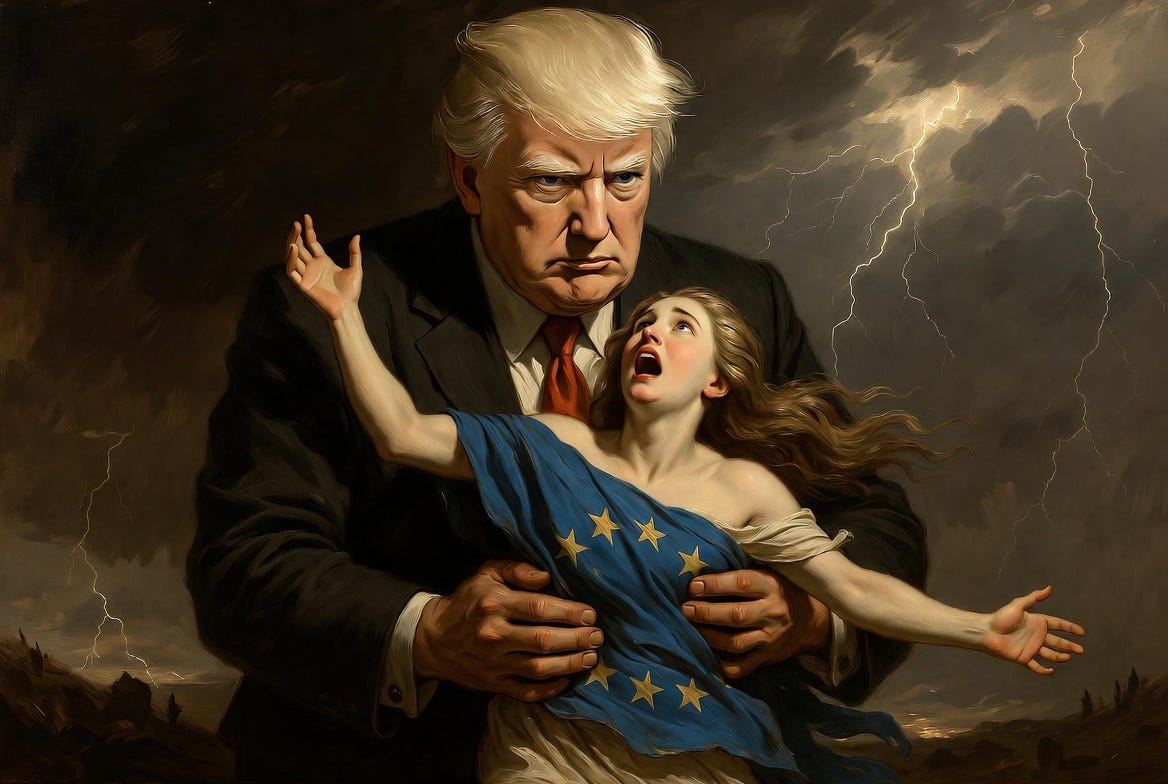
“Submission to Trump would be a historical mistake.”
—Jordan Bardella, President of “Rassemblement National”
How can we explain these words when only a few days ago, Jordan Bardella, the de facto leader of the French Right and long considered an admirer of Trumpism, openly antagonised the American leader who never hid his wish to see Marine Le Pen, the historical figurehead of the French Right, as the next president of France?
For several weeks now, Donald Trump has again set the tone of international politics, less through the spectacle of his personality than through the structural shift he embodies: the United States now exercises its power with an unapologetic directness that strips away the comforting vocabulary of partnership, shared “values,” and presumed alignment.
The Greenland episode, in which Trump publicly endeavoured to annex a territory belonging to a European ally, has functioned as a catalyst. Even though an immediate escalation seems to have been momentarily contained by provisional arrangements, the symbolic and psychological consequences remain. A central premise of postwar European self-understanding—namely that the transatlantic relationship rests, at least in principle, on a community of shared interests and mutual respect—has been shattered.
Between a Rock and a Hard Place
This is precisely what has put the European Right into an increasingly awkward position, one that reveals its unresolved contradictions with unusual clarity. Nowhere is this tension more visible than in the evolving stance of Jordan Bardella.
For years he has been suspected—sometimes fairly, sometimes through caricature—of a certain ideological proximity to MAGA rhetoric: the importance of sovereignty, borders, cultural identity, a suspicion of progressive moralism, and hostility to bureaucratic overreach. It seemed to some that Trump and France’s “Rassemblement National” (RN) were made to work together hand in hand (despite the latter’s regular criticisms of Trump’s tariffs policy).
Yet geopolitical reality has imposed a slow recalibration; a repositioning that has little to do with sudden moral indignation, and much more to do with the collision of three forces: the hard language of power politics, the psychology of European public opinion, and the particular burdens carried by any aspiring French president, for whom national dignity is not an accessory but a constitutive theme.
Of course, this evolution cannot be understood without reference to the exceptional configuration of contemporary French politics. The “RN” stands closer to power than at any moment in its history: opinion polls regularly place it at first position, while the traditional parties of government have largely collapsed.
At the same time, this apparent strength is accompanied by profound uncertainty. The ongoing judicial proceedings against Marine Le Pen, which may affect her eligibility, have transformed Jordan Bardella from a mere party leader into a potential presidential figure by necessity rather than design. In this context, foreign policy ceases to be an abstract ideological playground and becomes a test of national dignity and institutional maturity.
Trump’s Not So Veiled Contempt
This recalibration may be the symptom of a broader shift. At first glance, Trump’s second presidency seemed to offer European conservatives the kind of vindication after years of marginalisation.
After a first term often interpreted—rightly or wrongly—as chaotic and rhetorical rather than effective, his return to power appears marked by a more coherent and relentless agenda: rapid executive action, intensified border enforcement, deportations, institutional purges, defunding of ideological networks, a hard reassertion of industrial policy, expanded military posture, and an aggressive pursuit of technological advantage.
Many European conservatives, exhausted by the ritualised impotence of their own political systems, admire not merely the content of these measures but even the method: velocity, ruthlessness, and immunity to moral blackmail. In that sense, Trump seems to incarnate what continental conservatives have struggled in vain to achieve for many years amid coalition arithmetic, judicial activism, supranational constraints, and the mediatic regime of permanent scandal.
Yet this admiration collides with a contradiction that becomes more obvious the more Trump succeeds. His project is not a revival of a unified “Western Right,” and it does not presuppose European sovereignty as a good in parallel with the US’ sovereignty.
It is, above all, the reassertion of American primacy under a nationalist banner, a form of imperialist realism that treats alliances as instruments rather than moral commitments. Trump’s nationalism, thus, does not naturally harmonise with European autonomy, and the more the American state returns to an explicit logic of interest, leverage, hierarchy, and open bullying, the more toxic any perceived alignment with it becomes for European right-wing movements whose central promise is precisely the recovery of sovereignty. The result resembles an alchemical paradox: Trump may change domestic American politics into a new kind of energy, while turning European political proximity into a liability.
While Trump’s coup in Venezuela was a first important test showing the fractures between Washington and its privileged conservative allies on the “old continent”, the Greenland affair and Trump’s bid to annex European territory were experienced as open aggression and an outright breach of confidence.
That matters because European electorates—especially those sceptical of Brussels—tolerate weakness in their own elites more readily than they tolerate a humiliation of their civilisation. Criticism of European bureaucrats may be more than welcome, but contempt for Europe as such gradually triggers a different reflex, as it wounds a collective pride that still lingers in a society otherwise resigned to decline.

Bardella’s Refusal to Take It
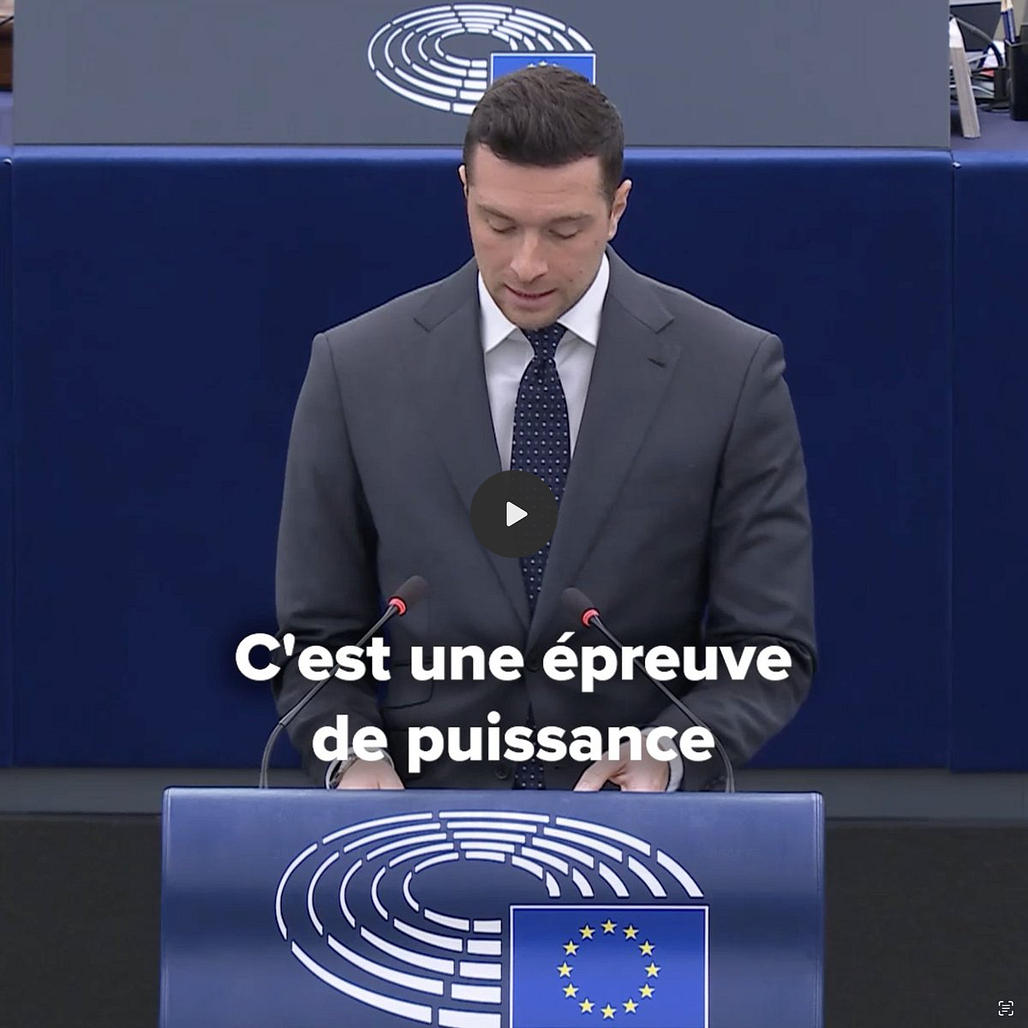
This is exactly why Bardella’s language began to change from one of readiness to partnership to one of increasing hostility. Not only did he condemn Trump’s handling of Venezuela; on 20 January 2026, speaking in the European Parliament, he also declared: “When an American president openly threatens a European state, combining territorial pressure with explicit commercial blackmail, submission would be a historic mistake.” Bardella thus positioned himself less as a convenient critic of Brussels who benefits from American rhetorical cover, and more as a defender of European dignity confronted with coercion. The underlying calculation is plain to see: any French presidential contender who appears as an accessory to foreign pressure risks being disqualified in a country whose political memory remains shaped, in complex and sometimes contradictory ways, by occupation, resistance, and a cult, though latent after decades of wokeism, of national grandeur.
Indeed, sensitivity when it comes to Trump’s bullying is not limited to the nationalist Right, as it is rooted in a much older French tradition that precedes contemporary party divisions. Since General de Gaulle, French political culture has maintained a structural ambivalence toward American power: an admiration mixed with distrust, leading to an alliance tempered by France’s insistence on autonomy. The withdrawal from NATO’s integrated command, the rhetoric of strategic independence, and the persistent belief in France’s diplomatic status as world power have left a mark on the national imagination, while the shameful retreat from Suez has never been completely forgotten.
Even Emmanuel Macron—despite his Atlanticist instincts—has repeatedly oscillated between confrontational rhetoric toward Trump and practical dependence on American security guarantees, revealing the unresolved contradiction at the heart of French foreign policy. For a right-wing candidate to appear more submissive to Washington than a deeply unpopular centrist president would therefore constitute not only a strategic error, but a symbolic inversion of France’s political grammar. Hence, it is wholly understandable that, only two days later, on 22 January 2026, Bardella even deepened the framing in a statement on X, where he wrote: “What is unfolding around Greenland is a test of power and truth for Europe. Donald Trump is forcing us to choose: either we accept subjugation, or we defend our sovereignty.”

This seems to be the point at which the dream of a transatlantic “international of patriots” becomes seriously jeopardised, as in a world based rather on empires stretching over entire continents than on moral virtues or civilisational affinities, states may align only temporarily and instrumentally.
Rumours of Revolt Elsewhere
Thus, European conservatives have started to feel that, while American conservatives may welcome them insofar as they weaken progressive networks abroad, disrupt regulatory obstacles, or fracture European coordination, they seem to have little reason to cultivate a Europe that could become an autonomous entity capable of defending its own economic and strategic interests.
Hence, similar fractures are also starting to show in Germany, where the “Alternative für Deutschland” is becoming deeply divided: one faction views Trump as a model of decisiveness and national revival; another fears that unconditional admiration would reduce Germany to a mere object of American bargaining, subject to economic pressure, energy blackmail, and strategic marginalisation. This internal tension is made even more complex by the AfD’s latent russophilia. Similar remarks could be made about the United Kingdom, where “Reform UK”, after an all-time high, seems to be under more and more pressure because of Nigel Farage’s strong ties to Donald Trump.
Thus, it is not impossible that a Canadian scenario might repeat itself in Europe. In the aftermath of Donald Trump’s return to the White House in January 2025, a series of remarks made between February and March—in which he evoked the possibility of integrating Canada into an expanded American strategic space, at times half-jokingly, at times less so—profoundly altered Canada’s political climate.
What initially was thought to become a near-certain defeat for Justin Trudeau’s Liberal Party, then polling below 25% after nearly a decade in power, suddenly was cast doubt on: during the election campaign in the Spring of 2025, Conservative leader Pierre Poilievre, repeatedly accused of ideological proximity to Trumpism, found himself placed on the defensive, while the Liberals succeeded in recasting the election as a referendum on sovereignty rather than governance and managed to retain power.
This telling episode illustrates how quickly foreign pressure can shake up political hierarchies—a truism whose relevance for European societies should not be underestimated.
Of course, Europe has a deeper dilemma: the temptation to outsource power.
Indeed, the recurring hope that salvation might come from an external champion—whether American, Russian, or even Chinese—is increasingly perceived as less a strategy than a confession of weakness, as it signals the erosion of the Right’s confidence in Europe’s own capacity for renewal.
A political movement that seeks its legitimacy from abroad implicitly concedes that it has lost faith in its own society. Bardella’s evolving discourse suggests an awareness, perhaps reluctant, that delegated power means constraint.
A right-wing movement that reaches office through foreign backing is already vulnerable to the accusation that it serves another master. Yet openly antagonising Trump comes at a price, too: while a posture of admiration toward Trump risks appearing submissive or naïve to the electorate, aligning with leaders and parties associated with the failures of recent years such as technocratic governance, moralising rhetoric, mass migration, industrial erosion, and geopolitical passivity, may also appear weak. Thus, Trump has involuntarily put the European Right into a very difficult situation, and may, by the very support he wants to give them while at the same time humiliating Europe’s lack of sovereignty, weaken their position.
Thinking Civilisationally Again
Paradoxically, Trump’s behaviour is thus reviving—almost against everyone’s intentions—an idea that seemed fantastical: Europe as a civilisational project and a necessary bulwark against other great powers seeking to dominate the world. Here one touches upon the central European question that has haunted the continent since the end of the Second World War and, in truth, since much earlier: Europe as civilisation and Europe as a political entity cannot be separated indefinitely without consequences.
The European Union, whatever its ideological distortions and administrative bloat, remains one of the few instruments through which Europe can still act as a bloc, particularly in domains such as competition law, digital regulation, industrial standards, and, potentially, strategic coordination.
Those who dream that a mere return to national sovereignty would automatically restore European freedom often overlook a harsh historical lesson: fragmentation in an age of empires tends to produce vassalage, and vassalage often disguises itself as autonomy until a moment of crisis.
Trump, in this sense, functions as an involuntary catalyst. By exercising American power without restraint, he forces European conservatives to confront what many preferred to avoid: the West is no longer a unified bloc, and Europe cannot survive as a moral theme-park or as an open-air museum of three dozen nation states while relying on others for its security.
A civilisation that cannot defend its interests, borders, industries, and culture will be treated as a territory to be cut up—by America, China, Russia, or even by Turkey.
So all the CPAC invitations of Ficos and Orbans were not expressions of brotherly Rightoid solidarity but cynical cultivation of useful idiots/willing assets to undermine a rival empire? Shocking, just shocking, how could they?