

by Europos
On June 16, 2015, Donald Trump descended the golden escalator at Trump Tower to announce that he would be saving his country.
“Our country is in serious trouble. We are not respected by anyone. We are a laughing stock all over the world…That is why today I am declaring my candidacy for President. I will Make America Great Again!”
And so much of how the soon-to-be President framed making the U.S. “great again” was about rejecting orthodoxies on the Right, especially Neo-Conservative foreign policy and its wasteful forever wars.
Alas, as an aging Trump falls into establishmentarian politics without reinvigorating the American empire, whose death-pangs he diagnosed three elections ago, the same old tension between a return to great power politics and nation-building quagmires remains in place. Yet now more than ever, Israeli interests are awkwardly interwoven:
Focus on Iran: While the harder-line Neo-Con obsession with advancing Israeli hegemony in the region, which would entail regime change in Iran, was temporarily sidelined after the ousting of Mike Waltz, the Middle Eastern nation still enjoys massive funding and controls the largest American conservative youth organization, Turning Point USA (TPUSA).
Focus on China: The desire to prioritise China and avoid distractions, represented by Vice-President J.D. Vance, is severely compromised by the fact that Vance’s political project precisely involves the massive integration of government with AI companies that are ideologically and financially committed to Israeli hawkishness.
And then there’s the ascendant rebellious base, but more on that later…
Pivot to China
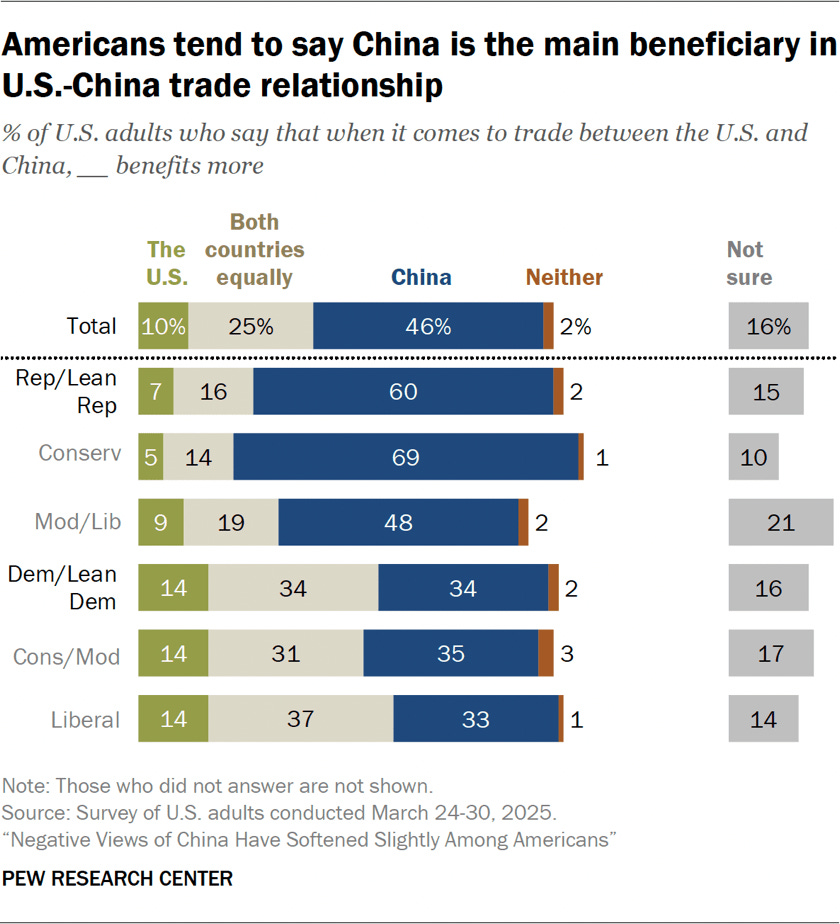
Vance, who Trump has said is the most likely person to lead Republicans in 2028, consistently emphasised Trump’s one-time focus on China as his priority: “China is the biggest threat to our country and we are completely distracted from it,” he said during a July 2024 Fox News interview, and has stuck to this sentiment since. This has also been the view of key Vance-supporter and leading voice in conservative media Tucker Carlson, and it’s a broadly popular position:
The Vance-line seems to be about bolstering the European Union and Israel as regional proxies to handle security burdens—encouraging EU Member States to increase their military budgets and take greater responsibility in the Ukraine conflict, and supporting Israel as the Middle East’s hegemon—while avoiding escalations with Russia and Iran, so that a strategic pivot toward containing China doesn’t get derailed.
Efforts by Trump to develop friendly relations with Russia, turning it into an eventual ally vis China, have thus far failed spectacularly, as Tucker Carlson has frequently pointed out
In practice, foreign policy momentum has drifted in the opposite direction.
As regards to the most volatile and most potentially entangling geopolitical quagmire, Trump has struggled to impose meaningful (or any) restraint on Israel, instead increasing military support for Jerusalem (of course, President Trump’s policy decisions on Israel have been influenced by significant financial ties to donors like Miriam Adelson).
In particular, curbing anti-Israel voices on U.S. university campuses, including threats of deportation for protesting students and funding cuts to institutions tolerating such activities, is consistent with the Trump administration’s plan to intervene in the Middle East to which it anticipates a backlash domestically.
Vance, for his part, has signalled that there is some daylight between himself and Netanyahu, partly because his foreign policy requires avoiding regional escalation, and partly because the younger Republican base is now solidly opposed to Israeli policy. The VP did not visit the Western Wall during his October 2025 trip to Israel, for example, opting instead to attend Mass at the Church of the Holy Sepulchre.
Here again, the strongest version of this line is represented by Tucker Carlson, who has taken a sharply critical stance toward Israel’s bombing of Gaza and questioned the strategic importance of this country: “[Israel has] no overriding strategic interest [for the U.S].”
Carlson’s platform has been instrumental for J.D. Vance, who has been a guest on his show multiple times, going back to a 2021 interview, with Carlson’s endorsement having played a pivotal role in Vance’s 2022 Ohio Senate primary victory.
Of course, for reasons of state, Vance’s positions are more moderate than Carlson’s, but he will need Carlson if he is to inherit the MAGA movement, in the course of which Carlson will be able to direct the electorate’s powerfully anti-interventionist and Israel-critical sentiments towards the Republican ticket in 2028.
Neo-Con Astroturfing
No organisation is better positioned to mobilise young conservatives than Turning Point USA (TPUSA), which boasts over 3,000 chapters on campuses and high schools as of 2025.
Erika Kirk, widow of Charlie Kirk, initially described Vance as a potential successor to her murdered husband and to MAGA in general. And yet, during later media appearances, she seems to have hesitated:
“Let’s start with the midterms before we start jumping to ’28…And let’s enjoy the fact that we do have Donald Trump in office, and we worked really hard to make that happen, my husband did.”
This change in tone may be a response to Vance signalling taking distance from the Israeli government. Post-Charlie Kirk TPUSA’s leadership is, if anything, even more uncompromising in its support for Israeli foreign policy interests than Kirk himself (who was at least wary of striking Iran).
However, in light of Erika Kirk’s growing unpopularity among segments of the MAGA base—consider how poorly received her CBS interview with Bari Weiss was—even if TPUSA’s funders were to turn against Vance, they would not be able to raise up a credible challenger.
Then again, they may not need to…
Silicon Washington
J.D. Vance owes his career to Big Tech, going back to his days at Peter Thiel’s Mithril Capital. The second Trump administration has overseen the fusion of Washington with AI companies (consider Project Stargate) and, given Vance’s connections to that business sector, we may expect him to push this further.
In terms of foreign policy, the question of how the military integrates AI becomes all-important: The groundwork has already been laid for AI oligarchs to exert influence over the Department of Defence. Crucially, these are likely to run interference on Vance’s China-pivot.
During his tenure as head of the Department of Government Efficiency (DOGE), Elon Musk influenced personnel decisions in the Department of Defence and facilitated the integration of Palantir Technologies’ software into several U.S. government departments, positioning the company as a central data aggregator.
This included deploying Palantir’s Foundry platform in the Department of Homeland Security for immigration tracking, the Department of Health and Human Services for public health data management, and the Internal Revenue Service.
But Palantir CEO Alex Karp is no neutral technocrat serving his country.
In a late 2023 interview he stated that he was “proud that we are supporting Israel in every way we can” and acknowledged losing employees over his views in 2024, signing an upgraded agreement with Israel’s Ministry of Defence in January 2024 to enhance that country’s AI-driven military capabilities. Fellow Palantir co-founder Peter Thiel has expressed general agreement on this point: “my bias is to defer to Israel.”
Palantir’s expanding integration into U.S. government operations could, therefore, embed technological dependencies or institutional biases favouring robust support for Israel, and complicate efforts by a future President Vance to curb U.S. involvement in Middle Eastern conflicts and pivot toward countering China.
We find another example of this in Palmer Luckey’s Anduril Industries, which has emerged as a pivotal player in AI integration for the U.S. military, securing important contracts. Apart from receiving support from Vance mentor Peter Thiel’s Founders Fund, critically, the company is building its flagship hyperscale manufacturing facility in Vance’s state, Ohio.
And, like Karp, Palmer Luckey has made it clear what his foreign policy orientation is, and who he is open to do business with, describing himself as a “radical Zionist,” saying “Israel has my [and our] unqualified support.”
This, then, is the great contradiction of Vance as MAGA heir, since Tucker Carlson’s Vance is not Silicon Valley’s.
Rhetoric aside, the VP represents the ascendency of an AI-oligarch class with very strong ideological and financial commitments to Israel, making it unlikely that he will be able to pivot the U.S. away from the Middle East.
The Groyper Guerrilla
A loosely organised faction of young fans of political commentator Nick Fuentes, the “Groypers”, has positioned itself as heir to the “America First” label; it emphasises strict immigration controls, Christian nationalism, maintaining a white majority in the U.S., and resisting Israeli influence (from AIPAC to Israeli intelligence).
Following its birth online in 2019, the group has since gained much traction through its disruption of conservative events, and especially after Tucker Carlson’s two-hour interview with Nick Fuentes in October.
This followed a partial easing of social media platform bans which had been in place since 2017, enabling Fuentes to reach millions and position himself as a voice for Gen Z conservatives.
Importantly, despite being a long-time supporter of Trump, Fuentes did not vote during the 2024 election, encouraging his followers to likewise abstain unless the candidate publicly stated his intention to impose an immigration moratorium and not bomb Iran.
Fuentes is also vocal in his criticism of administration-aligned AI companies, stating in a June 2025 post, “Seriously, if Palantir isn’t the deep state, then what is?”
In theory, the Carlson-Vance line on foreign policy is not so different from that of Fuentes, who does want the U.S. to act as global hegemon. Given Vance’s tech patrons and allies, however, it isn’t an exaggeration to say that Groypers represent one of the few prominent factions on the Right which is resistant to Middle East escalations and the integration of AI firms into government.
Of course, their prospects are limited.
Battlefield Ohio
Vivek Ramaswamy, Vance’s long-time friend (after whom the VP has named one of his sons) is running for governor of Ohio in 2026. Ramaswamy has framed the reindustrialisation of America as depending on companies like Anduril. “Palmer Luckey has good instincts” he wrote in a June 2025 social media post.
Making sure the Governor of Ohio facilitates Anduril’s activities is a key part of Vance’s vision for the U.S. military. Indeed, the Republican establishment has cleared the way for Ramaswamy, moving Jon Husted—who was Ohio’s lieutenant governor and widely considered a frontrunner for the 2026 Republican gubernatorial nomination—out of the way (Husted was appointed to fill J.D. Vance’s vacant U.S Senate seat in January 2025 by Governor Mike DeWine).
Fuentes, for his part, has described the 2026 Ohio gubernatorial race as a top priority.
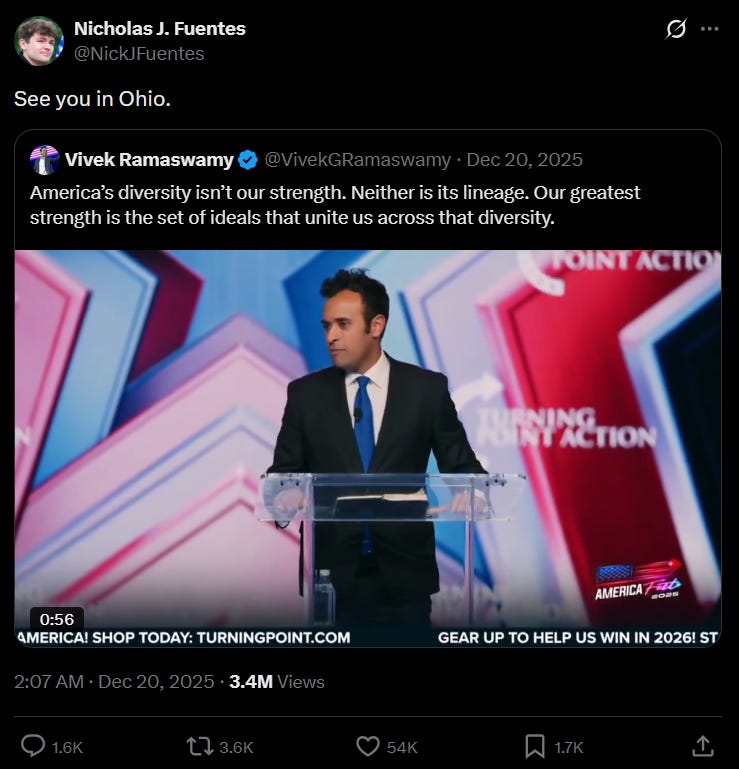
If dissident “America First” supporters can stop Ramaswamy from getting elected, they will effectively have shown the GOP that they are a force to contend with and represent a significant portion of the voter base. This may then force the party to make concessions to the Groypers’ harder-line on immigration and foreign policy.
Apart from demonstrating political capital, this would presumably slow the fusion of Washington with pro-Israel AI companies—albeit the latter is by now a fait accompli, and, in any case, the Republican (or Democrat) establishment does not adapt immigration and foreign policy to the desires of voters.
But the mobilisation of an anti-Trump, anti-Vance “America First” movement in 2026 might contribute to the development of an alternative political bloc able to compete with an establishment whose formidable resources will, however, be a determining factor in enabling Vance’s probable 2028 presidential run.
As long as the masses buy into the political circus, the machinery of technocratic totalitarianism will run full steam ahead. There is little to nothing that Fuentes can do to stop this, even if we assume he's not a bad faith actor setting-up Groypers to fail at some critical inflection point, which is very likely.
Couldn't agree more. Your previous piece on US geopolitical shifts really layed the groundwork for this insightful analysis. The connections are stark.