

by Marco Gallina
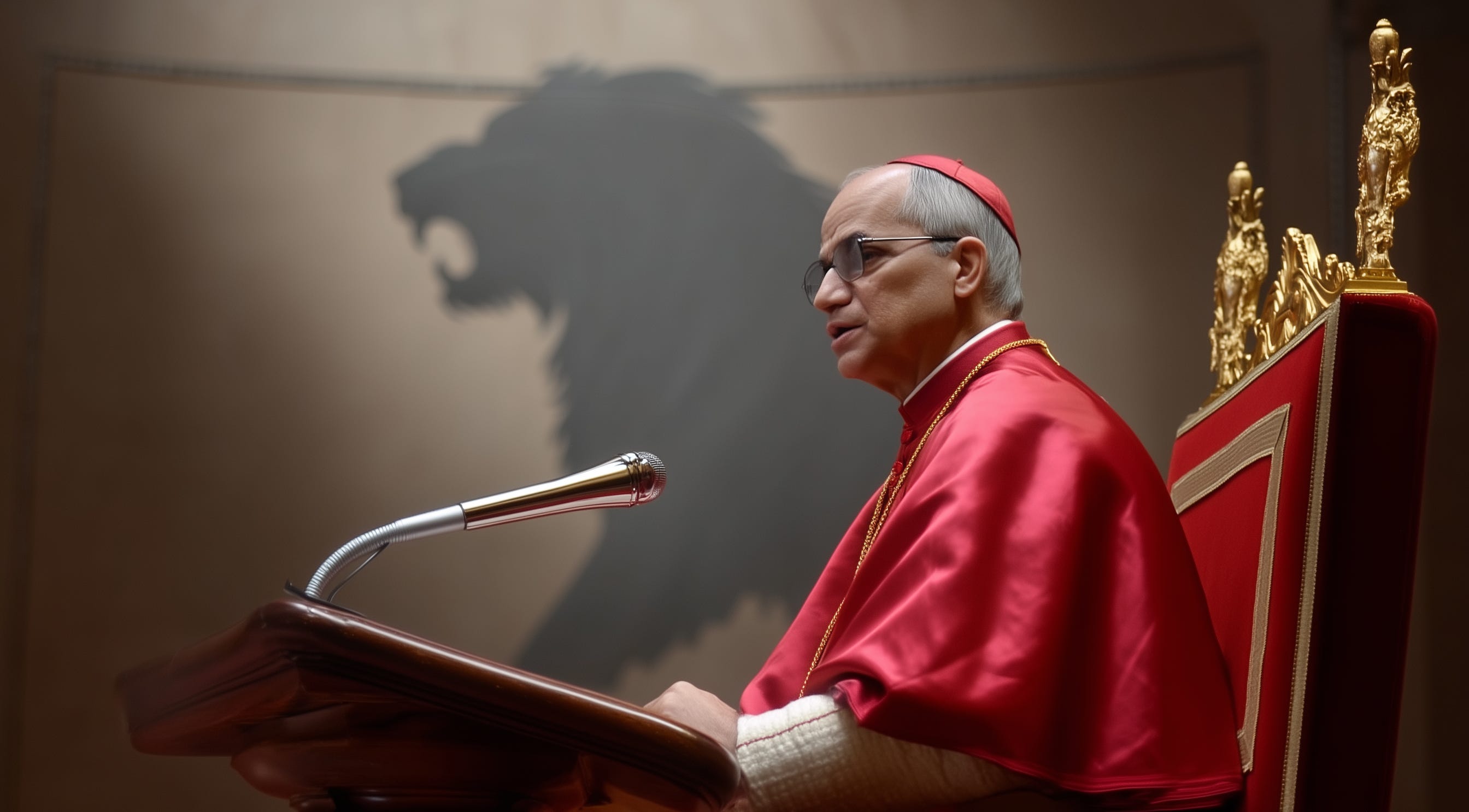
Pope Leo XIV has set the first caesura of his pontificate. Shortly after the last consistory of cardinals, he addressed the diplomatic corps with remarkable effect. The speech went viral, above all because he condemned the threat to free speech in the West. Quotes and short videos of the pope spread rapidly across social media.
His remarks, however, were not surprising. At his first general audience after the conclave, Leo had already spoken to assembled journalists, emphasising the value of freedom of speech and of the press while criticising ideological or political uses of language.
The core problem in media perception of Leo, particularly among American outlets, is the tendency to see him merely as the “US pope.” Accordingly, anticipation had built that Leo would use his address to diplomats to denounce Trump over Venezuela. On Friday, the illusion that Leo was simply an “anti-Trump pope” evaporated, as it so often does. The pontiff is not woke, however much some progressives still cannot accept this.
Beyond Francis II
This misjudgment stems from another. Both very conservative and very liberal circles want to see in Leo a “Francis II.” They cannot separate politics from theology. In truth, his predecessor Bergoglio was far more overtly political, at times raising fears that the Catholic Church might be demoted to a branch office of the United Nations. Yet climate change and migration are not issues the political left has patented, any more than abortion and gender belong exclusively to the right.
By virtue of its expected length alone, the Leo pontificate will not stand in the shadow of Francis. The reverse will prove true: the Francis pontificate will stand in Leo’s shadow, however it may turn out. At the consistory, Leo referenced not just the Argentine but his last four predecessors, pairing Paul VI with John Paul II, and Benedict XVI with Francis. The interpretation of the Francis pontificate should therefore proceed through the lens of Benedict, which, as with John Paul II in relation to Paul VI, would mean a conservative reading.
Leo apparently regarded 2025 as a transitional phase. The death of his predecessor and the Holy Year likely explain why the Holy Father pursued a policy of the steady hand. Unlike the two “transitional popes” before him, he has time to prepare his strategy. Leo’s accents so far have been subtle: the return of liturgical vestments from the Benedict pontificate, the return to the Vatican apartments, a summer visit to Castel Gandolfo. In the Catholic world, these are clear positions, not mere cosmetics.
Human Rights in Danger—Even in the West
Leo used his New Year’s address to sharpen his position. The essence of his remarks: human rights are in danger worldwide, and this applies not only to dictatorships but to Western democracies as well. The pontiff speaks of a “short circuit” in human rights, explicitly highlighting freedom of speech, freedom of conscience, religious freedom, and the right to life.
His starting point is Augustine. Leo invokes the Civitas Dei and observes: “We are now, as then, in an era of widespread migratory movements; as then, we are living at a time of a profound readjustment of geopolitical balances and cultural paradigms; as then, we are, in Pope Francis’s well-known expression, not in an era of change but in a change of era.”
Leo does not stop at noting that multilateralism has been weakened and that war has returned as a means of resolving disputes. He emphasises international humanitarian law—though, to the disappointment of some commentators, not with reference to Venezuela but in a context that evokes Russia’s attack on Ukraine: “We cannot ignore that the destruction of hospitals, energy infrastructure, homes and places essential to daily life constitutes a serious violation of international humanitarian law.”
Language as Weapon
The pontiff locates the problem deeper still. Multilateralism is possible only through exchange. Dialogue requires terms and concepts with clear meanings. This is no longer the case. Language has become a weapon. Terms are fluid, concepts vague. Language has become an instrument for winning arguments, for demeaning or insulting others. Without consensus on what words mean, destructive confusion reigns.
From this follows Leo’s central diagnosis: “We should also note the paradox that this weakening of language is often invoked in the name of freedom of expression itself. However, on closer inspection, the opposite is true, for freedom of speech and expression is guaranteed precisely by the certainty of language and the fact that every term is anchored in the truth. It is painful to see how, especially in the West, the space for genuine freedom of expression is rapidly shrinking. At the same time, a new Orwellian-style language is developing which, in an attempt to be increasingly inclusive, ends up excluding those who do not conform to the ideologies that are fueling it.”

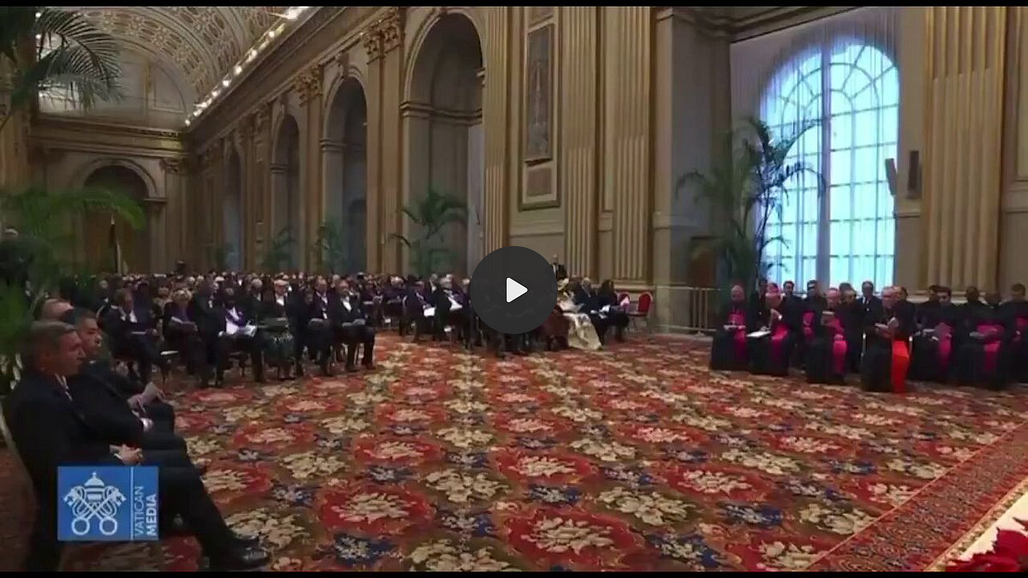
With the keyword “inclusivity,” the pope makes clear he is not merely echoing complaints that one political camp is abusing free speech for its agenda. Leo links the restriction of free speech directly to freedom of conscience. It is states that limit the conscience of their citizens, deploying slogans like “democracy” and “human rights” as cover. Practices such as abortion and euthanasia, but also conscientious objection to military service, are among the areas where state and society seek to override personal conscience. Instead of a free society, uniformity is the goal.
Religious Freedom as the First Human Right
Echoing Benedict, Leo calls religious freedom the “first of all human rights,” now under threat. The pope also points to the persecution of other religions. Some 64 percent of the world’s population now suffers restrictions on religious freedom. But he highlights the situation of Christians: 380 million believers are affected—one in seven Christians worldwide. Here Leo implicitly contradicted Cardinal Secretary of State Pietro Parolin, who recently downplayed violence in Nigeria as non-religious. Leo explicitly counted Nigeria among countries where Christians face persecution. In Mozambique, he noted, Christians are victims of jihadist violence.
Leo locates this form of persecution in majority-Christian countries as well. Like Benedict, who condemned relativism, Leo sees danger for Christians who commit themselves to the truth of the Gospel. It is a form of “subtle discrimination” through politics and ideology. The pope even accuses the UN of focusing too much on ideology rather than its core mission.
In this context, Leo turns to the right to life, bridging to his predecessor. Abortion, surrogacy, the value of the family, euthanasia—these have been the fields on which the Catholic Church, including under Francis, has spoken forcefully for decades.
A New Diplomatic Positioning
Leo did, of course, take a position on Venezuela, though less clearly than some had hoped. His appeal to respect the will of the Venezuelan people and to protect human and civil rights can be read against Trump’s special operation or against Maduro’s years of rule.
What matters far more to the American pope is repositioning the Catholic Church in the diplomatic world. His statements make clear that international organisations and multilateralism hold a special place. But Prevost evidently does not see the Church as a mere appendage to the world order, a “spiritual NGO.” Rather, Leo derives his tasks from Augustinian teaching in order to formulate political positions.
The changes under Leo are thus no longer mere decoration. The lion has found his voice.
Is the pope now a pop(e)ulist? A religion whose central worship is devoted to the divine Logos cannot tolerate the ideological deconstruction of language and its relationship to objective reality. The fact that Pope Leo addressed this issue in his recent New Year's address is not only a clear criticism of a very specific political movement, but also a position that is ultimately unavoidable from a theological perspective.