

by David Engels
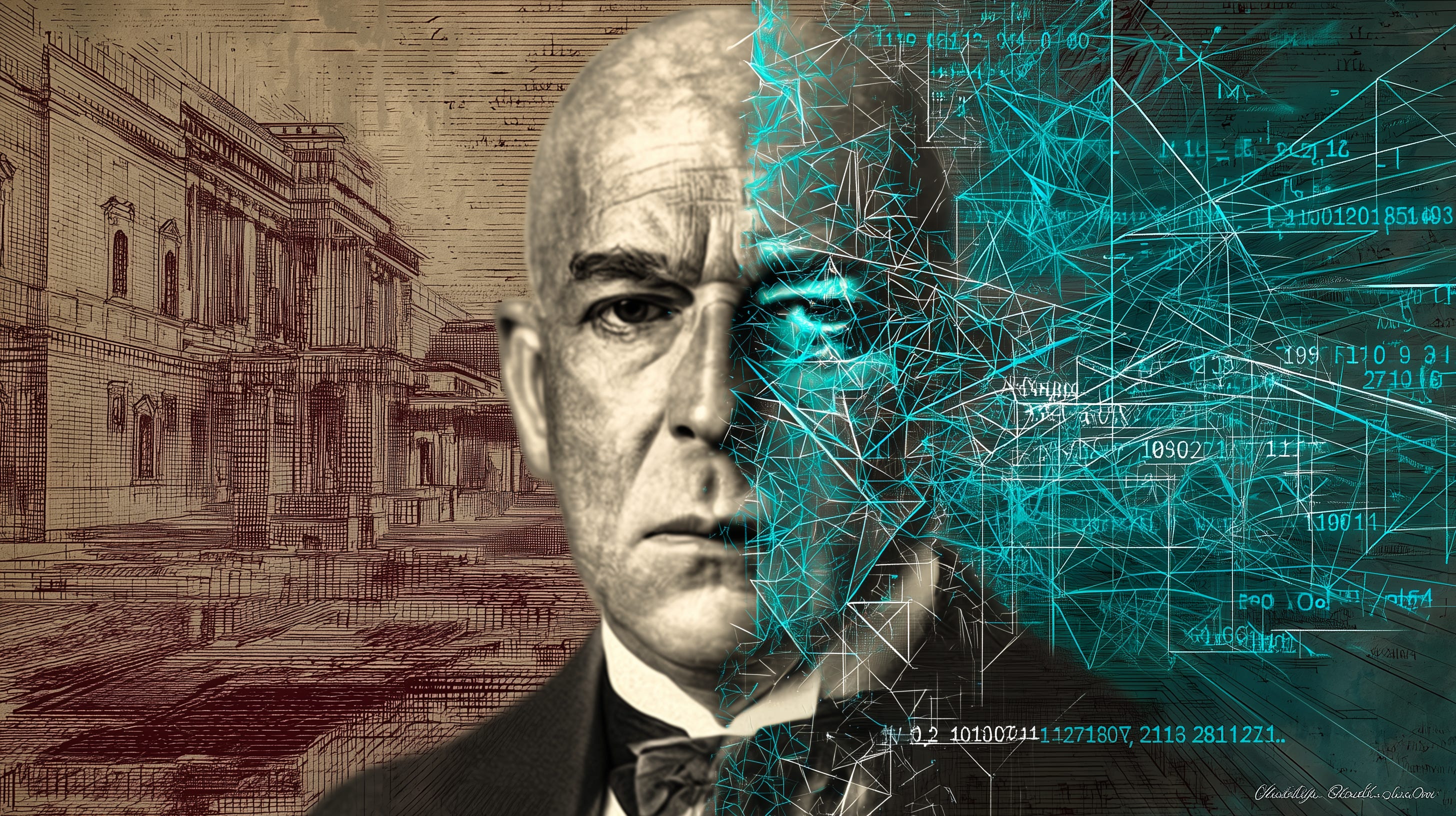
“The mechanisation of the world has entered on a phase of highly dangerous over-tension. […] All things organic are dying in the grip of organisation. An artificial world is permeating and poisoning the natural. Civilisation itself has become a machine that does everything in mechanical fashion.” (Spengler, Man and Technics, transl. Ch. Fr. Atkinson)
Few twentieth century thinkers offer a conceptual framework as well suited to the interpretation of artificial intelligence as Oswald Spengler.
Long before the digital age, Spengler described technology, not as just a neutral tool, but as an expression of a civilisation’s and evolutionary stage. From this perspective, artificial intelligence does not merely represent a technological breakthrough, but, it can be argued, shows itself to be a typical symptom of a late civilisational condition, characteristic of what Spengler termed the phase of Zivilisation—the exhausted, self-reflective aftermath of genuine creativity, which he he called the phase of Kultur.
During these last decades of incipient fossilisation, knowledge is no longer generated organically, but codified and rearranged. In that sense, AI emerges as the logical culmination of a long historical process, namely a technology that ceases to create meaning and instead recombines existing data according to statistical regularities. At the same time, artificial intelligence resonates profoundly with the “Faustian” soul of the West, whose defining impulse is to dissolve concrete reality into abstract forces and dynamic processes.
Seen through Spengler’s lens, AI stands at the intersection of civilisational exhaustion and the limits of metaphysical fulfilment—raising the question whether the West’s final technological achievement might also become its most dangerous illusion.
Late Civilisation and the End of Original Creation
In his writings, essentially “The Decline of the West” and “Man and Technics”, Spengler repeatedly insists that, while a culture is introspective, spiritual, artistic, and symbolic, a civilisation, by contrast, is extraverted, materialist, technical, and expansionist. The latter slowly becomes ossified, a process which is characterised by summarising and simplification. There are numerous examples of this. such as the Roman Empire post Augustus with its countless summaries, epitomes, florilegia, and copies, the Chinese civilisation since the Han dynasty with its retrospective canonisation of Chinese thought, or Ancient Egypt since the Ramessides and the ensuing slow ossifying of the civilisation near the Nile.
This diagnosis eerily applies to the epistemic logic underlying artificial intelligence. Contemporary AI systems prove incapable of generating meaning in any genuine sense, as was their initial aim: when all attempts at making a machine truly think failed, research shifted towards merely mimicking convincing results.
Hence the idea of identifying statistical regularities within immense datasets and recombining pre-existing conceptual patterns in order to achieve a result which, for the machine, has no true meaning, while, for the user, it only has one because the latter decided upon contenting himself with having a mere simulacrum of knowledge. Hence, modern AI’s strength lies precisely where late stage civilisations excel at, i.e. producing syntheses without any true creativity.
Artificial intelligence thus embodies the transformation of knowledge into pure function and is often celebrated as a “liberation” from human limitations. Yet from a Spenglerian perspective, all this marks only the completion of a long process: the outsourcing of intellect and the replacement of creativity by automated recombinations of past creative output.
We think only in horse-power now; we cannot look at a waterfall without mentally turning it into electric power; we cannot survey a countryside full of pasturing cattle without thinking of its exploitation as a source of meat-supply; we cannot look at the beautiful old handwork of an unspoilt primitive people without wishing to replace it by a modern technical process. Our technical thinking must have its actualisation, sensible or senseless. The luxury of the machine is the consequence of a necessity of thought. In last analysis, the machine is a symbol, like its secret ideal, perpetual motion — a spiritual and intellectual, but no vital necessity. (Spengler, Man and technics, transl. Ch. Fr. Atkinson)
A watershed moment, the advent of artificial intelligence thus appears as the logical endpoint of a culturally exhausted civilisation and now survives by endlessly rearranging the fragments of its own past.
Artificial Intelligence and the Faustian Soul
That such an evolution should originate in the Western world and nowhere else is no coincidence, if we recall that Spengler famously characterised Western civilisation as “Faustian”, i.e. driven by an inner urge toward infinity, abstraction, and the conquest of space and time.
Unlike Apollonian culture of Classical Antiquity, oriented toward visible form and harmonious proportion, or the Arabo-Muslim world, centred on inner revelation and the world as a sacred enclosure, the Faustian soul experiences reality as a field of tensions, vectors, dynamics, and invisible forces. Nature becomes a mere set of material data to be calculated, experimented with, dissolved, rearranged, used, and ultimately discarded. Mathematics replaces form with function; perspective dissolves the bounded world into infinite depth; technology becomes the privileged means of turning metaphysical longing into material power, or, in Spengler’s words:
By numerical experience man is enabled to switch the secret on and off, but he has not discovered it. The figure of the modern sorcerer a switchboard with levers and labels at which the workman calls mighty effects into play by the pressure of a finger without possessing the slightest notion of their essence is only the symbol of human technique in general. The picture of the light-world around us in so far as we have developed it critically, analytically, as theory, as picture is nothing but a switchboard of the kind, on which particular things are so labelled that by (so to say) pressing the appropriate button particular effects follow with certainty. The secret itself remains none the less oppressive on that account. (Spengler, The Decline of the West, Volume II)
In this light, artificial intelligence appears as the culmination of long-standing Faustian tendencies, operating through abstraction raised to an unprecedented level: language reduced to statistical vectors, images transformed into numerical patterns, reasoning modelled as probabilistic inference, and content submitted to the ideological fiction of late liberalism’s optimism about endless progress.
What once required human knowledge, intuition, imagination, and judgment is now merely imitated through computation. From such a perspective, it would therefore be unduly optimistic to celebrate AI as a real step toward augmented intelligence or even post-human cognition (as though either were in itself a cause for celebration), as such naive interpretations uncannily echo Spengler’s warning that Faustian culture tends toward self-dissolution through civilisational exhaustion and excess abstraction.
AI: The Last Invention of the West?
And yet, many interpret AI as the beginning of an entirely new phase in the history of technology, surpassing even the first industrial revolution and the invention (or rather large-scale use) of the steam engine–how could one see AI as an end instead of a beginning?
Contrary to the modern belief in linear progress, Spengler rather argued that, broadly speaking, technological creativity behaves anticyclical to the evolution of art, religion, philosophy, and political form. This means that it only thrives when true artistic and spiritual creativity wanes; its thriving is however bound to be rather short-lived: once the civilisation has spent its last energies on a purely material expansion, it inevitably fossilises.
Of course, this fossilisation is first hidden by the systematic application and exploitation of already existing technologies (which for example explains the seeming blossoming of the Roman Empire despite its technological and cultural stagnation); but gradually, it, becomes more and more obvious through the canonisation, standardisation, simplification and finally, decline of technology, leading the civilisation back to its primitive origins.
Obviously, expecting Western technology’s decline and fall right at the moment of the large-scale implementation of artificial intelligence and use of robotics may first appear as overly pessimistic.
Yet already in the 1930s, Spengler observed the elites slowly disengaging from the active shaping of technology, a trend which, almost one century later, becomes ever more obvious :
The Faustian thought begins to be sick of machines. A weariness is spreading, a sort of pacifism of the battle with Nature. Men are returning to forms of life simpler and nearer to Nature; they are spending their time in sport instead of technical experiments. The great cities are becoming hateful to them, and they would fain get away from the pressure of soulless facts and the clear cold atmosphere of technical organisation. And it is precisely the strong and creative talents that are turning away from practical problems and sciences and towards pure speculation. Occultism and Spiritualism, Hindu philosophies, metaphysical inquisitiveness under Christian or pagan colouring, all of which were despised in the Darwinian period, are coming up again. It is the spirit of Rome in the Age of Augustus. Out of satiety of life, men take refuge from civilisation in the more primitive parts of the earth, in vagabondage, in suicide. The flight of the born leader from the Machine is beginning. Every big entrepreneur has occasion to observe a falling-off in the intellectual qualities of his recruits. But the grand technical development of the nineteenth century had been possible only because the intellectual level was constantly becoming higher. (Spengler, Man and Technics, transl. Ch. Fr. Atkinson)
From this perspective, artificial intelligence appears less as a breakthrough inaugurating a new epoch than as the final stop in a long technological trajectory.
The more complex a system has become, the more dependent it is on regularly maintained infrastructure, rare materials, backup alternatives, and stable social conditions. Civilisations in decline, however, are increasingly characterised by political fragmentation, economic strain, over-bureaucratisation, and cultural exhaustion, where lack of creativity, knowledge, and outer constraints by foreign contenders make it gradually descend into primitivity.
Within this framework, AI may well constitute the apex of Western technological ambition, followed not by further victories, but rather by simplification, regression, partial breakdowns, and the remaining of only the most rudimentary tools. Or in the words of Spengler:
“This machine-technics will end with the Faustian civilisation and one day will lie in fragments, forgotten — our railways and steamships as dead as the Roman roads and the Chinese wall, our giant cities and skyscrapers in ruins like old Memphis and Babylon. The history of this technics is fast drawing to its inevitable close. It will be eaten up from within, like the grand forms of any and every Culture.” (Spengler, Man and Technics, transl. Ch. Fr. Atkinson)
The Faustian Pact
From a Spenglerian perspective, artificial intelligence thus appears less as a rupture than as the culmination of the Faustian trajectory. It concentrates the late civilisational tendencies that have long shaped Western modernity; not inaugurating a new cultural form, but simply condensing and accelerating processes already underway, pushing them toward their final point of exhaustion.
Spengler repeatedly insisted that the final phase of a civilisation is characterised by immense technical sophistication combined with spiritual sterility. In this sense, AI exemplifies the paradox of late Western civilisation: an unprecedented capacity to process information coinciding with a dwindling ability to generate genuine meaning. Knowledge becomes omnipresent, instantly accessible, yet increasingly detached from lived experience, ethics, creativity, and metaphysical depth. The machine “knows” everything, while Man gradually forgets why the ready recalling of knowledge even mattered in the first place.
The Faustian dimension adds an interesting, yet ambiguous final layer. Like the mythical hero Faust, Western man is ever insatiable and, at least in his “civilised” phase, seeks power without wisdom. Artificial intelligence promises precisely this: an externalisation of intellect capable of surpassing human limits; the ideal tool for a project bent on transforming the entire globe into an abstract flow of data ready to be submitted. Faust literally sold his soul to the devil in exchange for limitless power and knowledge. Whether the consequences of AI will follow this paradigm and lead Western civilisation to an outright descent into hell instead of a mere gradual decline into primitive conditions remains an open question, though the analogy is difficult to ignore.