
Did Britain Take Back Control?
A decade after the Brexit referendum, Britain had seemingly left the EU’s institutions behind — yet its elites went on to pursue nearly identical policies. By Kaiser Bauch.


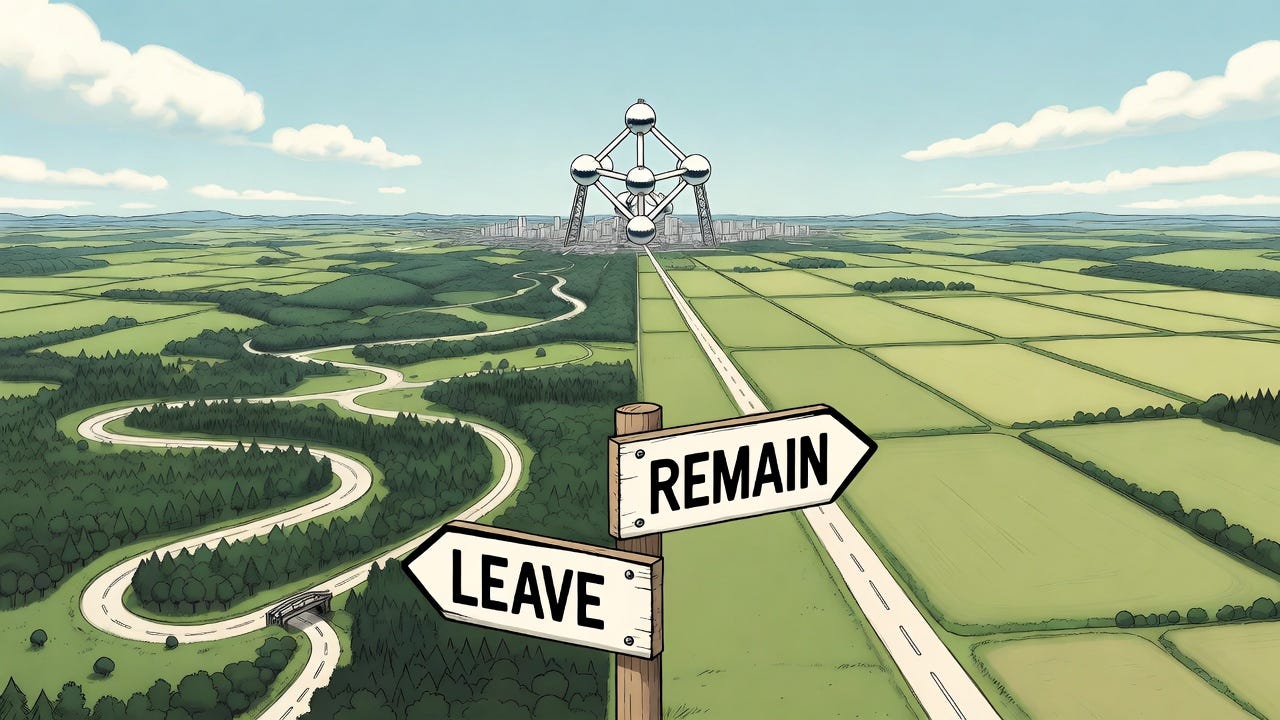
Ten years ago, on a Friday morning on 24 June 2016, now Reform leader Nigel Farage appeared in front of gathered journalists at a press conference in Westminster with that characteristic triumphant grin on his face.
It was the morning after one of the 21st century’s seminal political events in the West — the long-awaited Brexit referendum, in which the British nation decided whether it would stay in the European Union or pursue an independent path.
Looking at Farage — a man who had spent decades working to get Britain out of the EU — one could already guess the result without seeing a single number. He then declared that 23 June should go down in history as “our Independence Day,” alluding to the 4th of July, the biggest American national holiday, on which date the US gained its independence from none other than the British Empire.
And soon enough, just a couple of months later in November, Americans defied most predictions and voted Donald Trump into the White House. It was after this historic moment — declared by some a sign of the tragic decline of the liberal democratic order due to a populist wave, and celebrated by others for more or less the same reason — that Western politics entered a new stage.
A decade later, the world has changed so much that 2016 seems, in many respects, like a distant memory. Yet some things have stayed remarkably similar. Donald Trump is still, or is once again, residing in the White House. Nigel Farage is still at the forefront of British politics, and in the running to become the next British PM. But what can be concluded with certainty is that, so far, the promises made and believed by those who campaigned and voted “Leave” in the referendum have not been fulfilled.
The First Post-Brexit Decade
The past ten years have not been among the merriest in the long and glorious history of the island monarchy. Britain has had six prime ministers in ten years — a level of government instability we might traditionally associate more with Italy than with the nations of the European northwest.
The British economy has been in a malaise since the 2008 financial crisis, and its GDP per capita grew by less than 4% over the 2016–2024 period, lagging behind even such renowned growth “rockets” as Italy, Japan, or France. Labour productivity has grown by only 0.4% on average since 2008.
On top of that, British society is convulsed by ethnic strife and growing distrust among parts of the population toward the political establishment. Numerous scandals, from the grooming gangs to the recent murder of Henry Nowak, have entrenched the belief among a non-negligible part of the British population that the state treats different groups within the population differently. In 2024, 31% of Brits thought that the police treated those of Muslim background with more leniency than other groups, and 36% thought that the far right was treated harsher than other groups.
‘British decline porn’ has become its own genre in recent years, and it is hard to get through a day without seeing an article announcing that Britain is now poorer than Mississippi, the poorest US state, or that Poland is about to overtake Britain in GDP per capita in the near future. One might get the feeling that the sun is finally setting over the centre of the former British Empire.
One of the problems with Brexit was always that there was no real consensus, either among that section of the elite pushing for it or among many of the voters, on what it should achieve.
Some politicians, such as Boris Johnson, emphasised the vision of “Global Britain,” the Singapore-on-Thames. Using Britain’s rich historical ties to the wider world, it being a former colonial power, it would prove far more dynamic than sluggish continental Europe, turning the UK into a knowledge-based, startup-driven financial superpower.
Others emphasised Britain’s constitutional tradition instead, which they saw as being under threat by Brussels. A great many Leave voters simply used it as a way of protesting against a political system they increasingly felt did not represent them, or perceived Brexit as a possible impulse for Britain to escape its post-2008 stagnation, without giving too much thought to what would follow.

Moreover, while the long and painful road to the realisation of Brexit — full of tedious negotiations over minutia concerning trade and borders, and the sensitive question of Northern Ireland especially — finally came about on 1 January 2021, the issue lingers.
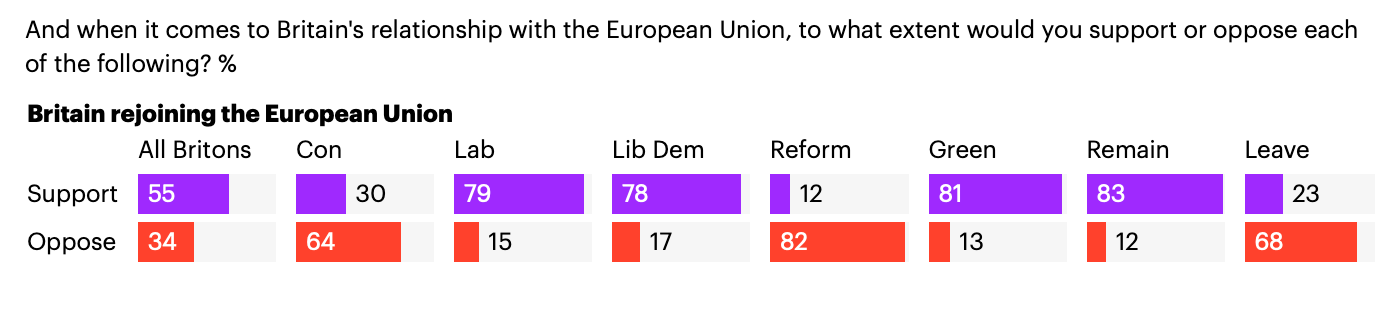
According to a recent poll, 55% of Brits would support rejoining the EU, while only 34% would oppose it. The question of forging some kind of renewed relationship with “the continent” is often brought up by politicians on the British left, such as former PM Keir Starmer or his successor, Andy Burnham.
Similarly to the previously mentioned “two-tier policing,” views on this issue have a strongly political connotation: while rejoining the EU enjoys overwhelming support among Labour and Green Party voters, those of Reform UK are staunchly opposed to it.
The debate about Brexit’s legacy is muddy and complicated, since the UK’s regained sovereignty coincided with a stream of global events with severe consequences of their own. Covid — or, more precisely, the political response to it — sent shockwaves through the economy and society. This was followed almost immediately by the war in Ukraine, which further disrupted energy markets.
If one were to draw a simple line from Brexit to today, one would conclude that Brexit was clearly bad for Britain, because the country has not
been doing well ever since.
But that would be an oversimplification, ignoring — apart from the fact that its economic stagnation predates Brexit, as outlined above — the most interesting part of the mosaic: that British political elites have maintained a peculiar level of continuity with the EU when it comes to some of its most controversial, and arguably damaging, policies.
Greener Than Brussels
One of the major drivers — one might even say obsessions — of EU policy for at least a decade has been the drive to lower CO2 emissions. In this crucial field, the baseline goal of achieving so-called net-zero CO2 emissions by 2050 has remained unchanged across successive Conservative and Labour governments.
The UK has the highest industrial electricity prices of any developed country — roughly 3.5 times Canada’s, and 46% above average. Domestic prices are the second-highest, with only Germany surpassing them. Net-zero-related costs make up roughly 8–16% of a typical bill.
Crucially, nearly all of these policy costs are loaded onto electricity bills rather than gas bills, even though households consume roughly three times more gas — so electricity ends up being penalised relative to gas, which works against the goal of having people switch to electric heating and EVs.

 | A guest post by
|