

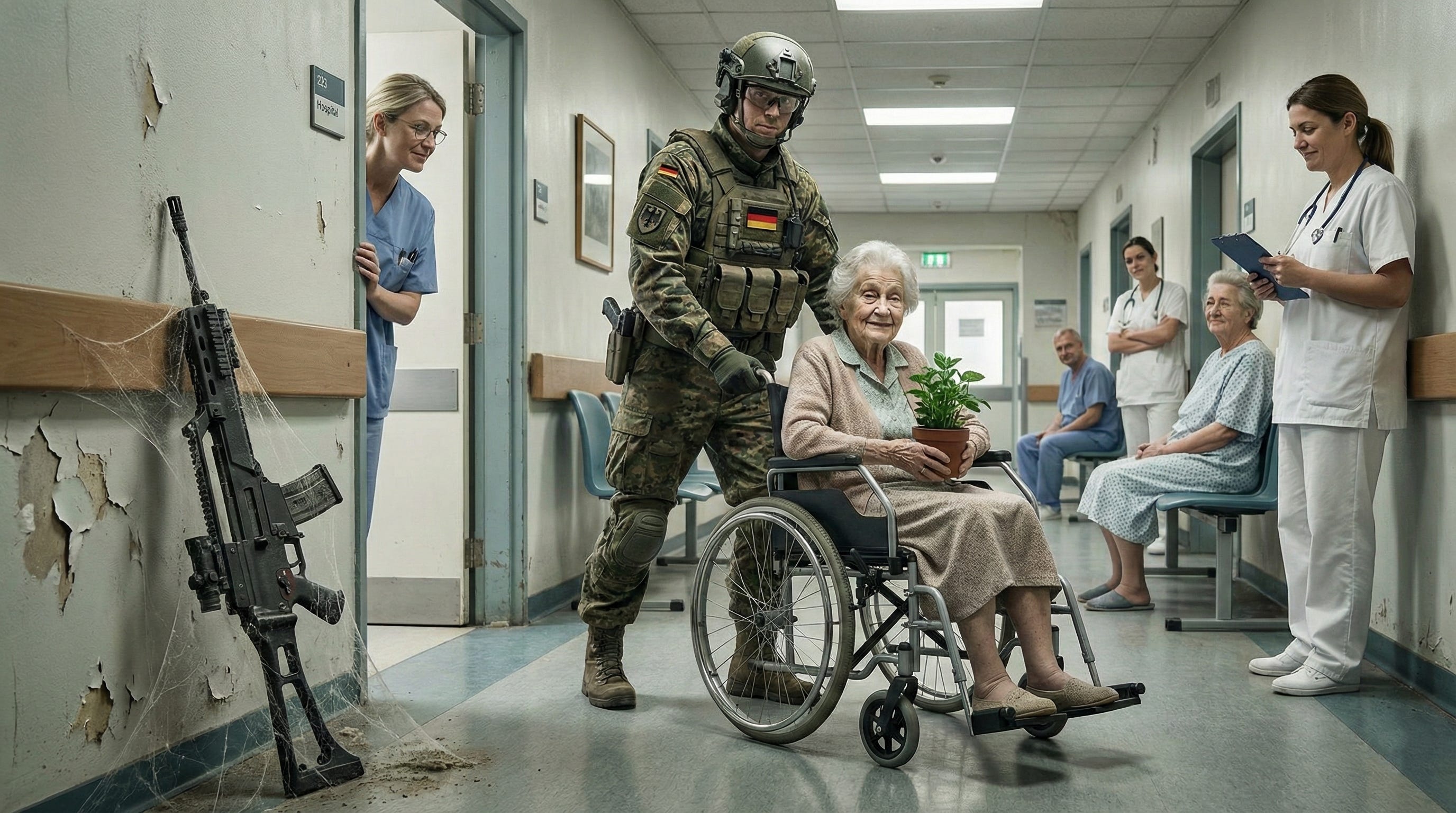
That the Germans are a neurotic people has been known by their neighbours since at least the 19th century.
One more or less, or so one would think, can hardly do any harm. But former Chancellor Angela Merkel, who flirted with multiple neuroses during her tenure, proves otherwise.
Merkel’s time in office saw the introduction of “marriage for all” by a party (the CDU) that calls itself Christian Democratic; after decades of championing energy security and nuclear power, it also led the nuclear phase-out and the energy transition. Under her leadership, the CDU, which had previously advocated security and control over Germany’s borders, became the architect of mass migration.
And so, the conservative wing of the CDU in particular was left to bleed out, only to end up being completely dismantled.
To this day, one “reform” that broke with the CDU’s principles remains little noticed abroad: the suspension of conscription in 2011. For many CDU members, this de facto abolition under a different name counted as a betrayal. The “citizen in uniform” belonged to the great myths of the Federal Republic after the “dark era” of the Wehrmacht. Paradoxically, it was precisely conscription that was supposed to be the guarantor of democracy, to end the supposedly martial spirit that had animated Prussia as well as the Third Reich.
That the Bundeswehr was already suffering from grave problems at the time conscription was suspended has been ignored by nostalgics. In the years before the suspension, inequity in military service was rampant. Young men were either “called up” arbitrarily or without being offered clear guidelines. Unsurprisingly, military service was more often than not characterised by humorous anecdotes and riotous beer evenings, which was considered the norm since the 1980s.
Nevertheless, the Bundeswehr myth persisted, partly buttressed with dubious arguments, such as that young men would otherwise learn no discipline in their lives. These mostly came from the mouths of that generation which partly bears responsibility for Germany’s present decline.
A Belated Suspension
In fact, Germany was rather belated when implementing the suspension. Numerous European NATO states had switched to the professional army model long ago to respond to the changed global situation after the Cold War.
Germany’s sluggishness was also due to domestic political considerations: those who refused military service were drafted for civilian service. The German state profited from this cheap labour in the social sector, for which no replacement could be found—or at least, not as quickly.
The latter is an indication of what the actual motives of the federal government were. It was less about modernising the Bundeswehr than about possible savings. The new strategic situation played a subordinate role. For as much as the completely useless conscript army was glorified by those who had “served”, the German public actually had just as little interest in the armed forces.
For years, the Bundeswehr participated in the war in Afghanistan without politicians, the media, or even the population particularly taking much notice of the deaths of their country’s soldiers. The designation of a “state of war” was categorically avoided so as not to violate the actual provisions of the Basic Law—which, post-war, envisaged the Bundeswehr only as a defensive army acting within German borders.
That this prevented the use of military equipment during deployment or better protection for soldiers, because these were only intended for when the country is in a state of war, is one of those German peculiarities.
Not only in times of conscription was the lack of equipment a permanent issue. Even after the “Zeitenwende” following Russia’s attack on Ukraine and a billion euro package for the Bundeswehr, the deficiencies remained the same.
Defunct submarines and helicopters were merely the tip of the iceberg. Recruits complained about being able to train only with dummy weapons. Even military aircraft had broken down, so that Bundeswehr soldiers sent for deployment abroad had to be put on commercial Lufthansa flights.
The AfD and the Preserved Position
Despite these circumstances, the suspension remained highly controversial at the time. In a transfiguration of the true circumstances, conscription became a talking point of the newly founded AfD just a few years later. Just as the then-young party adopted an anti-EU stance, criticised Germany’s energy policy, and later its migration policy, it also saw the suspension of conscription as a grave mistake. Ironically, the persistently poor state of the Bundeswehr became the basis for arguing that this could only be remedied by reintroducing conscription. The AfD soon made its reintroduction part of its programme.
It is not without irony that the AfD has thus preserved a CDU position in recent years, and now, with Germany having reintroduced conscription, speaks out against it. When it was reintroduced, it was done most hastefully, which became painfully obvious when it appeared that the district recruitment offices that used to examine whether young men were fit for duty no longer even existed. And why their weapons training should run smoother when equipment is already scarce in the smaller, but professional army remains a mystery.
A frequent argument that the federal government advances is the shortage of personnel. Compulsory service does not necessarily improve the number of soldiers, however—nor morale. Especially not when neighbouring Poland demonstrates that one can assemble a much larger army solely from professional soldiers.
Poland can field 230,000 soldiers, while Germany can only field 184,000—although Germany’s population is twice as large. To attain such numbers, one must create incentives. These are not merely material in nature. To die, one must love something. However, Germany has given the younger generation in particular sufficient reasons to despise their own fatherland, and above all their own government.
Technology Instead of Numbers
Above all, the question arises why a conscript army should protect Germany when what counts is less numbers of men than technological advantage. The Ukrainian theatre of war, which served as the official trigger for reintroduction, shows precisely that specialists, expertise, and drones are more decisive than infantrymen. For an entire generation of Russian and Ukrainian soldiers, the battlefield has become a meatgrinder. Are these really the lessons the federal government draws from the Ukraine war?
The points listed demonstrate concretely what was described at the outset: conscription is a German neurosis. In this nation, nostalgia and magical thinking go hand in hand—as soon as conscription returns, or so our leaders think, everything will be well.
That the governing Social Democrats in particular might bet on propping up the social sector through the revival of civilian service seems obvious. Initially, the SPD even wanted compulsory service for both sexes—perhaps in the hope that enough young women would choose care work rather than the frontlines.
In Germany especially, the phenomenon of conscription is accompanied by a bizarre discussion about patriotism and ideological positioning. The rejection of conscription was branded as latent treason to the fatherland in right-wing circles. The credo was that at least one conservative value was now being restored. That there are numerous politically conservative systems worldwide that do not regard conscription to be such a value is beside the point—the German Sonderweg has been described sufficiently.
The Forgotten History of Conscription
What is far more astonishing is that numerous right-wingers and conservatives have apparently forgotten the historical context of conscription. The idea that war alone forms the man may be an ancient notion. The Christian Middle Ages and the early modern period are considerably more nuanced in this regard.
Out of a Prussian impulse, the 19th century is projected onto world history. Not only writers like Dante or Goethe, but also politicians like Metternich or thinkers like de Maistre would have to be re-evaluated. De Maistre saw conscription as the cause of a ‘civil war of mankind’ (guerre civile du genre humain). Metternich feared a ‘people’s war’ and, even during the Napoleonic Wars, advocated arming the wealthy farmers and citizens rather than introducing universal conscription.
The above examples then show how absurd the discourse on this issue is. The truth is: historically, conscription was introduced by the Left. It is the legacy of the French Revolution, since it were the revolutionaries who fought royalist-conservative Europe with mass levies.
Most of the “great Europeans” who the West lauds never served in the army before the 19th century—and if they did, it was voluntarily, as with Miguel de Cervantes. Indeed, one of the reasons for the uprising in the Vendée, where the Catholic-conservative population rose against the Jacobins, was the introduction of the levée en masse.
The German Right has thus preserved a leftist-radical tradition. This too is rooted in nostalgia and romanticism. Even at the beginning of the 20th century, the memory of the Wars of Liberation against Napoleon was alive and well. That Prussia could defeat Napoleonic France with its German allies was due to the adoption of conscription.
The authoritarian state quickly knew how to handle this newly acquired instrument; an instrument it was then, as now, loath to relinquish. For unlike in the ancient poleis or other democratic states, the introduction of conscription in absolutist monarchies was not accompanied by emancipation. Largely from 1848 onwards, citizens had to fight for that themselves. This shows that the nation-state granting rights to its citizenry and conscription are not necessarily historically connected. With the erosion of civil liberties and the reintroduction of conscription, the thought arises that once again it is not the defence of the homeland that matters, but rather the securing of the state’s interests.
I’ve been following this conscription talk in Canada and the UK. There isn’t much tradition of conscription beyond the world wars in such countries, but there seems to be a vague boomer longing to turn young people into slaves. There is also hostility to young from the old, and the desire to make sure they don’t enjoy life too much.
As patriotism hollows out, there is the idea that forced labour will recreate a nation. And furthermore, as you point out, as social services collapse in an aging society, the thought of free or cheap captive labour appeals.
Here in Ontario we have the idea of 40 hours of mandatory “volunteer” work to graduate high school students. In practice this means charities are pestered by unmotivated students and let them hang around with blank stares as an act of mercy.