


On the 30th and 31st of July 2026, between 49,000 and 60,000 people illegally crossed into Ceuta from Morocco, creating an extraordinary situation and some genuinely shocking pictures.
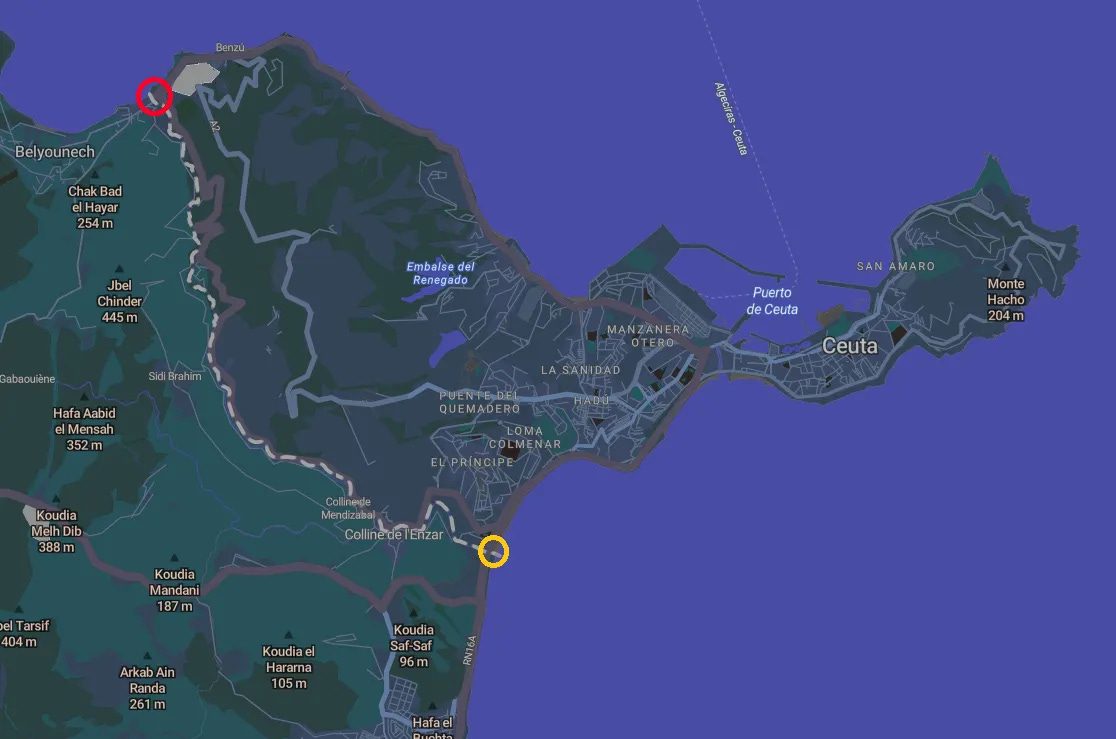
[MAP — via cartes.app: El Tarajal marked in yellow, the secondary passage towards Benzú in red]
Given the fog of news and the nature of social media, a great deal was said and shared very fast, usually without context, with the blanks filled in by ideology. Right-wing politicians called it an invasion, Ayuso and Abascal chief among them; the NGOs called it a humanitarian crisis; Ceuta’s own government begged Madrid to declare a national emergency, and Madrid refused.
Commentators from viewpoints as far apart as pro-Palestinian activists and anti-immigration European hard-right critics converged on the same explanation: that the Moroccan government was behind it, echoing past weaponisations of migrants such as the 2021 border dispute. An abundant series of takes from the far right immediately seized on the images to claim an invasion of “military-aged men” by Morocco, instrumentalising the situation into another culture-war topic and projecting American grievances about “woke nations”.
In the middle of all this, Italy suspended Schengen with Spain, France reinforced its border controls, an Israeli ambassador used the occasion to get back at Madrid over Gaza, and Trump didn’t miss the opportunity to take a dig at the Democrats.
From all of this, two narratives coalesce. Either Morocco opened a gate and organised or pushed the masses, or fifty thousand people organised themselves, opened it themselves and overwhelmed the security forces on both sides. I will go through both properly, with the help of the Moroccan and Spanish press, which both have interesting evidence for either narrative.
But I will say now where I end up, so you know what you are reading toward. I don’t think the question is well posed. Three separate things happened here, and they do not share a clean explanation: fifty thousand people decided to go, the line at Tarajal and Benzú did not hold, and most were home by Saturday. Most of the commentary answers the first question using the second question’s evidence — trucks, policemen “participating”, thin police lines — as proof that somebody assembled the crowd, when at most it explains why the crowd got through.
Early July 2026: The Faint Trigger
To understand what happened at the Tarajal and Benzú beaches we have to go back one month, to a courtroom in Madrid. On the 29th of June 2026, Section V of the administrative chamber of the Spanish Supreme Court handed down ruling 814/2026. The case was, at this point, small and old. An Algerian man had been intercepted swimming toward Ceuta on the 14th of November 2024 and handed straight back to the Moroccan authorities without due process. The court concluded that this can no longer be done, because it infringes on his rights. Devoluciones en caliente — “hot returns” — are, according to the court, not lawful for people who arrive by sea.
The conclusion was that each person has to be given an individual procedure under the Foreigners’ Law, with a lawyer and the right to ask for protection, as well as a hearing. But it does not stop the Spanish authorities from removing him afterwards, and most importantly it does not apply at all to the fence or land borders, because “rejection at the border” was written for physical barriers, and a swimmer isn’t touching one.
The ruling was made public on the 8th of July and newspapers discussed it around the same time. The strongest evidence that this was a trigger is that the Spanish Interior Minister claimed there had been no sea arrivals into Ceuta between January 2026 and the 15th of July — and the first cases of sea arrivals in the area started around the 17th to 20th of July.
Mid-July 2026: Sánchez Visits Algeria
On the 20th of July, Pedro Sánchez landed in Algiers. It was his first visit in four years.
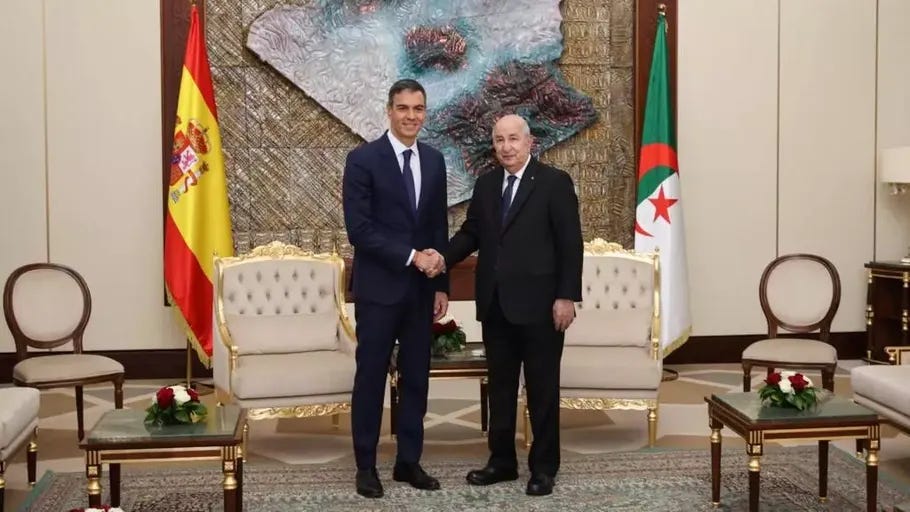
The reason goes back to March 2022, when Spain abandoned decades of neutrality towards the Algerian–Moroccan conflict and endorsed Moroccan autonomy over Western Sahara. Swiftly afterwards, Algeria pulled its ambassador, suspended the friendship treaty and effectively stopped trading with Spain. Getting that relationship back was worth real money, with Algerian gas being a welcome commodity. So Sánchez went to Algiers to talk about energy, illegal migration and the Sahara.
Morocco’s entire diplomatic posture since 2020 has been to make the Sahara the single measure of any bilateral relationship, and it has punished European capitals for much less. The timing is at minimum awkward, and El Español reports that Guardia Civil high command reads the whole crisis as the sum of two things: the Supreme Court ruling and that flight, the trip having produced deep malaise in Rabat. Hold on to this information, we’ll come back to it — but note the dates as you go, because the first sea arrivals appear around the 17th and Sánchez lands on the 20th.
The Role of Social Media
None of the above explains how fifty thousand people found out, or even had the motivation to go. Rulings and state visits are how governments talk to each other. What seems to have been an early precursor to the movement was a Facebook group called “Hrraga Ceuta”,1 documented by El Faro de Ceuta on the 27th of July, four days before the border broke. It seems to have been full of people posting photos of wetsuits and fins, asking which taxi goes to Belyounech, warning each other about checkpoints, selling flippers out of Casablanca and pooling money for a kayak.
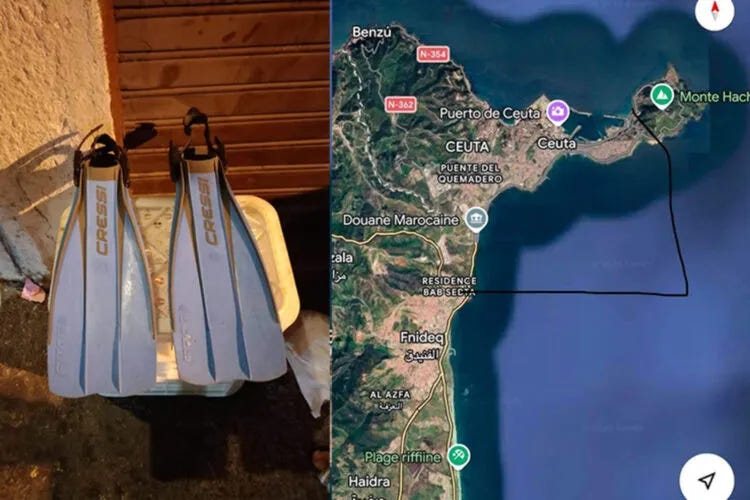
Adding force to this, it has all happened before. In September 2024, in the same town, a call went round TikTok and Facebook under a coded date — see you on 15/09 — and hundreds converged on Fnideq for what everyone called the night of the great escape.2 Morocco arrested 152 people for social media incitement, a twenty-year-old in Tetouan got prison for a single video, and the Moroccan Ministry of the Interior said it had blocked over 11,000 attempts in M’diq-Fnideq province in one month.
So we have two strong candidate stories, and they are not strongly mutually exclusive: the thesis that a crowd assembled itself and stormed the border, and the thesis that the state assembled and facilitated it.
Thesis One: Organic Desperation
The main gist of this thesis can be summarised as follows. Nobody organised this. A reservoir that had been filling for six years found a hole in the wall on the one day of the year when everybody was free and half the state was busy saluting.
The context
To start, we have to talk about Fnideq, the town bordering Ceuta to the south.
For decades Fnideq lived off contrebande vivrière — the smuggling of goods through Bab Sebta. Locals of the border towns near Ceuta had a special privilege compared to other Moroccans: they could go into Ceuta for the day and return in the evening without a Schengen visa.
Some of those locals are porters called ferracha, women carrying bales through the crossing on their backs, with an entire informal economy hanging off the fact that Ceuta is a duty-free port glued to a poor province. Middle East Eye put the number at over 9,000 people fed by that trade in Fnideq alone. The state’s counter-argument was a good one: the same smuggling trade cost the Moroccan economy something like €650 million a year in lost customs and displaced domestic production.
So in 2019 Morocco closed Bab Sebta to the smuggling, and then in March 2020 Covid closed the border entirely for eighteen months — even to the locals who worked on the other side. The local economy was gone. This is quantified by the unemployment rate, which according to Le Desk stood at 18% in the M’diq-Fnideq prefecture already in 2019, roughly double the national rate, before the shock. The Moroccan government has tried some compensation schemes, but they were modest against the scale of what was displaced.
Not long afterwards, the privileged visa regime tightened, so that even residents of Tetouan and Fnideq who had crossed daily for work their whole lives now needed a Schengen visa to enter Ceuta, with further effects on local employment.
Widening this out a little, even in the rest of Morocco there is a constant pressure valve, given that more than one young Moroccan in three is a NEET (not in employment, education or training). Youth unemployment hit a record 37% in 2025, with over 1.5 million actively looking and failing. The minimum wage went up 5% to around $300 a month, which is not enough compared to the inflation rate, and everyone knows it. Read another way, it is evidence that a rumour of papers in Europe is worth the risk.
Some readers might object: why don’t the young stay and fight for their rights instead of running to Europe — improve their homeland, call out the corruption of the government, ask for better jobs? Well, they actually did.
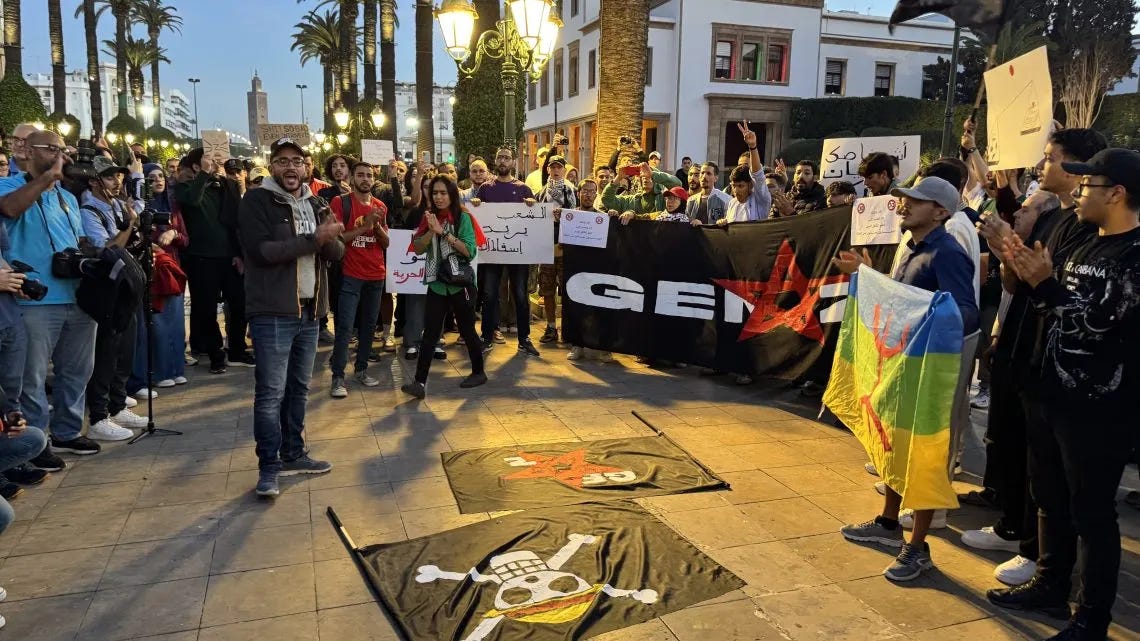
This cohort had already gone into the streets once, in September and October 2025. The GenZ 212 movement mobilised young Moroccans in Rabat, Casablanca, Agadir, Meknes, Tangier and dozens of smaller towns for three weeks, demanding hospitals, schools and jobs instead of shiny World Cup stadiums. The movement was leaderless, organic and organised on Discord.
What happened next is that the government cracked down on them, with over 400 arrests and two dead. It was the largest youth mobilisation since 2011, in the aftermath of the Arab Spring, and the state answered it with a meek finance bill promising health and education money and subsidies for young candidates. But such changes take time and trust, which the naked corruption of the elite and the politicians does not help cultivate.
Such conditions produce a reservoir of people, but the reservoir is constant. The interesting question is why people ran to the train stations and buses on this exact date.
The date: Eid al-Arsh
Eid al-Arsh, or Throne Day, is a celebration of the Moroccan royal house that falls on the 30th of July. This year was the twenty-seventh anniversary of Mohammed VI’s accession, and a national public holiday. This year the King used his Throne Day speech to address “جيل Z” directly — Generation Z, the generation of dreams and determination — while citing 4.9% growth in 2025 and Morocco’s rise as an African industrial power in cars, aviation and renewables.
Several things converge on that date and point towards the organic thesis.
A festive day. No work, no school, no classes, and rather cheap intercity transport running at holiday frequency. This is the unglamorous answer to the question the orchestration thesis thinks is unanswerable: how did fifty thousand people physically get to a small border town without state organisation?
They got there the way Moroccans get anywhere on a long weekend — by bus and by train. AP’s detail about the burned vehicles at Fnideq is the giveaway: the dozens of motorbikes and informal taxis cleared away by dump trucks belonged to people who had come from Kénitra, 260 kilometres away, and Marrakech, 630 kilometres away.
Half the northern security apparatus was on royal protocol. On the 30th of July at midday, the King presided over the Throne Day reception in the square of the M’diq-Fnideq prefecture, in the city of M’diq (Kech24, Chamalpress, Admath). M’diq is roughly fifteen kilometres from Fnideq and sits in the same prefecture. On the 31st he was at the Mechouar of the Royal Palace in Tetouan for the new officers’ oath-taking ceremony and the ceremony of allegiance, plus a lunch at the Royal Guard club.
A royal visit in Morocco is not a mere photo opportunity. It involves an entire security envelope: DGSN, DGST, Gendarmerie Royale, Forces Auxiliaires, Royal Guard, road closures, sterile zones, motorcade routes, rooftop posts and so on.
So for two consecutive days the entire northern security establishment was geared around protecting the King in the Tetouan province, on the two most protocol-heavy days of the Moroccan calendar, in the exact same province as the crossing point. There is good reason to think that whatever was left over was what stood at Fnideq, and that it was thinned out on those days.
El Mundo reported that only 55 Guardia Civil agents were on the line when the breakwater went. This also supplies the boring explanation for AMDH’s Achraf Maimouni telling AP that the Tarajal border was “opened under unusual circumstances” that morning: a skeleton crew at a choke point on a national holiday is an unusual circumstance.
This is the strongest single argument against orchestration. No state stages a hybrid-warfare provocation fifteen kilometres from where its own King is standing, on the anniversary of his accession, with the crown prince beside him and every foreign ambassador in the country watching.
The risk of it going wrong — as it did — and shaming a country that is trying very hard to project the image of an orderly developing nation is not a risk any competent security service would accept on this specific date. Had they orchestrated it, they could have picked any other day but the King’s.
The rumour
As mentioned above, Supreme Court ruling 814/2026 seems to have been a faint trigger, because the facts of the case were shared loosely on social media and, via a game of telephone, eventually became a rumour: that if you swim to Ceuta they give you papers, and in some versions that the border was simply open, so all you had to do was hop on something, get to Ceuta and collect your papers.
Marocmedias makes this point too: instead of the legal version, the simplified rumour ran on social media. Reuters found Ayoub El Abyad, sixteen years old, who said he and his cousin decided to make a twelve-hour journey to Ceuta after watching videos on Instagram. Many other interviews and first-hand testimonies show people saying they got the information via TikTok, YouTube Shorts and Instagram Reels.
There are already some leading points giving credence to this, as the infrastructure was already there and two years old, as we discussed in the introduction.
Thevoice.ma describes the same behaviour from the Moroccan side: groups sharing departure points, best hours for swimming, how to avoid patrols, some selling equipment, participants from cities all over the country.
Further evidence comes from the pattern of September 2024 in the same town: a call circulating on TikTok and Facebook under a coded date, see you on 15/09. That was enough to converge hundreds on Fnideq for “the night of the great escape”.
But they did not only stop people back then — it seems they did so this time as well.
The Moroccan state’s reaction
If Rabat opened the tap, you have to explain the following, because all of it is Moroccan press of varying quality dated the 29th to the 31st, describing a nationwide emergency mobilisation against its own citizens’ movement.
Fes. Local authorities suspended all departures toward northern cities, from both the Bab Boujloud bus station and the central train station (TelQuel Arabic, Aljarida24, Kech24). Maroc4 adds the detail that finishes the argument: over 140 passengers who had already bought tickets north were refunded under standard procedure.
El Jadida. Security alert at the train station to prevent over 400 people, most of them minors, from travelling north (Aljihaouiya).
Casablanca. Maximum alert at Ouled Ziane bus station and at the Casa Voyageurs and Aïn Sebaâ train stations, plus monitoring along the urban ring road toward Rabat, sustained from Thursday into Friday (Hespress).
Oujda. Around 50 people, including sub-Saharan migrants, physically prevented from boarding a northbound train they were attempting to board by force without tickets; identity and travel-document checks imposed on all passengers (Maroc4).
Nationally. Dozens of young people detained at stations across the country, along with people suspected of organising the trips (Telegraphe).
On the road. The Gendarmerie intercepted a bus from Casablanca carrying 36 candidates, and Al3omk and Le Desk report 1,500-plus detained and the coastal strip sealed already on the 28th of July.
At Fnideq itself. The beach closed, dozens stopped before reaching the water (Al3omk). Water cannon and tear gas, around 30 arrested on the Friday morning (Assabah).
Look at the geography of that list: Fes, El Jadida, Casablanca, Oujda. Oujda is on the Algerian border, 550 kilometres from Fnideq. El Jadida is on the Atlantic. This looks like a national operation, running in every direction at once, on a public holiday, against people who in most cases had committed no offence beyond buying a train ticket.
So we can conclude that the Moroccan government deployed force at transport nodes hundreds of kilometres inland to stop the crowd from ever assembling.
What it did not do was use serious force, because it could not. The cost of a Moroccan security force firing on, or beating to death, a crowd of its own teenagers on Throne Day, fifteen kilometres from the King, in front of fifty thousand phone cameras, with the footage going global inside an hour, is an unpalatable reputational cost.
The state had spent late 2025 managing GenZ 212 with budget concessions after two protesters died and the international coverage turned. The one thing the Moroccan state could not afford in July 2026 was a massacre at Fnideq at the hands of its own forces.
So it was left with the weakest tools in the box: interdiction, arrests, tear gas, water cannon, closing bus stations in cities — against a crowd that had already decided to go.
Weak points
Despite all this, the thesis still has weak points.
(a) Desperation is constant. Fnideq has been broke since 2020 and Throne Day comes every July. The NEET rate does not move month to month, and none of that produces a curve. A structural explanation that explains every day explains no particular day.
(b) The pre-existing curve is not explained either. By the end of April 2026, land arrivals to Ceuta stood at 2,101 against 489 the previous year, roughly a 330% increase, and Frontex had logged a 66% increase on the Western Mediterranean route in Q1 (Tanja24).
January to June land arrivals were 2,582 against 978. That is months before the ruling and months before Algiers. Something already changed in early 2026, and “people are poor” does not identify what.
(c) Fifty thousand in a day is a different kind of number. Rumours reliably produce crowds. September 2024 produced hundreds, and AMDH’s count for the 27 July attempt was roughly a hundred people reaching Ceuta (Kech24). Three days later the figure is between 48,000 and 60,000. Two orders of magnitude in 72 hours, on the same rumour.
(d) It cannot rule out the passive version. Nothing above is inconsistent with a Moroccan state that genuinely tried to stop the crowd assembling in Fes and Casablanca and was also in no particular hurry to reinforce one gate at Tarajal for a few hours on a day when its King was in the next town.
(e) The El Español claims are not refuted. They claim Moroccan intelligence officers were seen on the border cameras and that gendarmes were filmed moving people in trucks; the New York Times found Moroccans who say officials encouraged them. “Weakly sourced” is not “false”, and this thesis currently has no positive account of the truck footage.
Now let us explore the evidence for the opposite view.
Thesis Two: State-Orchestrated Weaponised Migration
The main gist of this thesis is as follows. Morocco has done this before, on the record, and got what it wanted. Spain went to Algiers on the 20th of July, and ten days later fifty thousand people walked into Ceuta while Moroccan gendarmes watched. This is a foreign policy instrument with a documented history and an element of hybrid warfare.
Precedents
What this thesis points towards has already happened, in May 2021. It is documented at the level of a European Parliament resolution and nobody serious denies it.
For context: Spain admitted Brahim Ghali, the Polisario3 leader, for Covid treatment under a false identity in 2021. Rabat was told and objected. Then, over two days in mid-May, Moroccan border police eased controls at Fnideq and around eight to nine thousand people crossed into Ceuta, at least 1,200 of them unaccompanied minors. AFP watched Moroccan guards leaving people largely unimpeded. The European Parliament’s June 2021 resolution states it flatly: Moroccan police temporarily eased border controls, opened the gates of their border fence and did not act to stop illegal entry.
El Español‘s May 2021 investigation supplied the operationally specific mechanism. The mkadem are the lowest rung of the Moroccan Interior Ministry — neighbourhood officials who know every family on their street — and they spread the word that the border would open after Ramadan. They knew exactly who was vulnerable, which young men were unemployed and looking at Europe.
Buses were filled and driven to the fence, gendarmes were photographed opening the gates, and Moroccan informants inside Ceuta and Melilla — who normally feed Rabat intelligence on migration, drugs and terrorism — supplied the coordinates of where to enter. Benzú and El Tarajal were selected, and holes were cut in those fences with the help of the authorities.
Then, when Madrid had absorbed the message, the same police who had facilitated it turned around and beat the crowd back with batons, producing a pitched battle at Fnideq (Castillejos in Spanish) with the very people they had waved through days earlier.
So on that occasion the pattern was: facilitate, then suppress, then deny. Defence Minister Margarita Robles’ response at the time was that nobody plays games with Spain, implying that Madrid read it as blackmail.
But it seems that Sánchez decided otherwise, and the blackmail worked. In March 2022 Spain reversed its long-held position on Western Sahara, abandoning decades of neutrality to endorse Moroccan autonomy — ten months after the weaponised migration incident. Whatever else you believe, the 2021 operation extracted the single largest diplomatic concession Rabat has won from Madrid in fifty years.
The strong argument for this thesis, then, is not “would Morocco do this” but “Morocco has done this, it was profitable, and it has never been punished for it”.
There is a diplomatic casus belli
As explained towards the start of this post, Sánchez visited Algeria on the 20th of July 2026, ten days before the incident. The agenda in Algiers, according to El Español, was an energy alliance, how to deal with illegal immigration, and revisiting the Sahara conflict.
Spain going to Algiers to discuss migration cooperation is seen as Spain shopping for an alternative gatekeeper in the Maghreb, and discussing the Sahara is reopening a file Morocco believes it closed in 2022. Morocco’s entire post-2020 diplomatic doctrine is that the Sahara is the sole prism through which it judges any international relationship, and it has punished Berlin, Amsterdam and Paris for much less. This is also the reason Morocco signed the Abraham Accords in December 2020, regularising its relationship with Israel: because of the Western Sahara question.
Videos of trucks, police cooperation and intelligence officers
Videos went viral on the 30th and 31st of July showing trucks and coaches unloading young men close to the border while Moroccan police and Royal Gendarmerie stood by without intervening. Catalunya Press and Periodista Digital carried this video and Clash Report pushed it internationally on X.

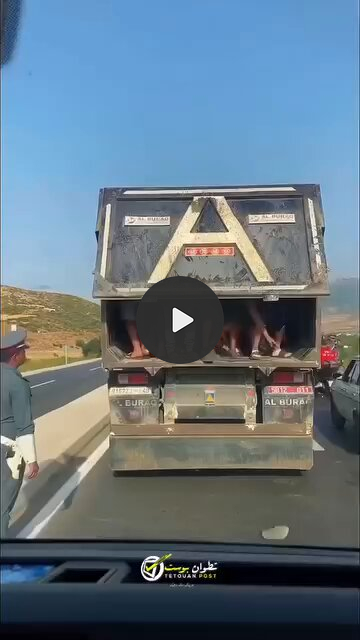
The most damning version of the claim, logged at Maldita.es, is that a Moroccan police officer permits a truck to approach the border, dozens of people climb out of the trailer, and once they are all out the officer signals the driver to close the trailer door.
Added to this is the presence of intelligence officers. From the same El Español article quoted before, sources say that Guardia Civil analysts, watching the border camera system in real time, identified members of the Moroccan intelligence service moving among the crowd in the first hours of the 30th.
This is not new; the same thing has been observed in earlier pressure episodes at Ceuta and Melilla, including in 2021. Spanish intelligence sources seem to corroborate it and say an operation of this character is part of hybrid warfare and could not have been carried out without the active participation of the internal services operating in Morocco.
Lorenzo Gabrielli of Pompeu Fabra, who researches migration at Ceuta specifically, told the New York Times that it is impossible for nearly 50,000 people to cross the Morocco–Spain border in a single day without Morocco having a hand in it.
From Moroccan civil society, Achraf Maimouni of AMDH in northern Morocco told AP that the situation was exceptional and that the Tarajal border was opened that morning under unusual circumstances. This is a Moroccan human rights monitor, not a Spanish nationalist, which lends the argument more credence.
Given all of this, however, this thesis has stronger weaknesses than the 2021 precedent would suggest.
Weaknesses
(a) The sourcing is not what it looks like. Every claim about 2026 traces to anonymous Guardia Civil and Spanish intelligence sources, published by one newspaper, El Español, in a week when that newspaper’s own headlines called it an orchestrated invasion, and when Spain’s domestic politics was consumed by whether Sánchez should have declared a national emergency he explicitly refused to declare. The camera footage of the alleged intelligence officers has not been published. Nobody outside the Instituto Armado has seen it. And the claim does not prove what it appears to: intelligence services observe mass border events on both sides — that is their function. Presence at an event is not authorship of it.
(b) Many of the truck videos are simply unverified and are being used to push culture-war narratives on X and elsewhere. A point towards this is that the people who spread them went straight to Trump and Netanyahu. Take this video, for example.
It has been debunked: it was a policeman who emptied and stopped the truck at a point on the highway 50 kilometres south of Ceuta. As the linked Italian article notes, it would have taken the passengers eleven hours to walk to the border. Factually, the video is just a policeman emptying a truck in the middle of a highway, with no other contextual information.
As for why a merchandise truck would be transporting people: I will have to offer an anecdotal piece of information here. In Morocco, as in many other countries, a level of informality and corruption still exists. Given that the authorities stopped trains and buses going north, it would not be out of this world for a trucker seeking some extra profit to post himself near the bus station and tell people that for a small fee he would take them north. In this case, the most probable thing is that the police simply stopped one of these “entrepreneurs”.
Meanwhile the account that made it viral, José Vico, captioned it as definitive proof of a strategy by the Moroccan dictator in connivance with Trump and Netanyahu — which does not help make it an argument of serious weight.

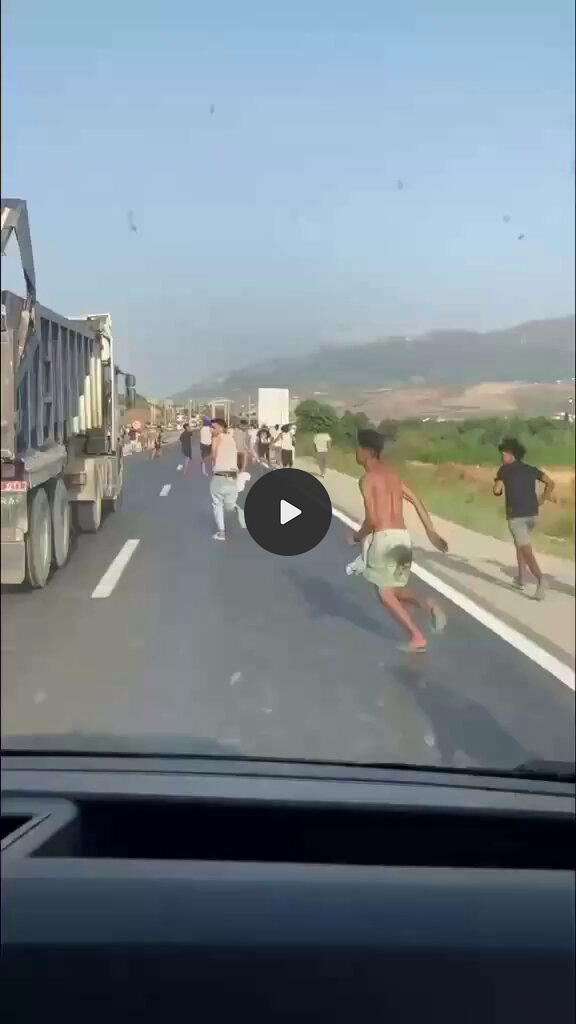
Note also what the footage can and cannot show. Trucks and coaches carrying passengers, in a country where trucks and coaches carry passengers under dubious legal conditions, is ambiguous. The specific claim about the officer signalling the driver would be damning if verified, but it has not been.
(c) The mkadem article is from 2021. The El Español piece cited above, describing how mkadem filled the coaches and gendarmes opened the gates, is circulating now as an explanation of 2026 — but it was published on 20 May 2021 and describes the 2021 operation. Recirculating a five-year-old operational account as evidence for a new event is not evidence, as past actions do not predict future performance. I concede this is a weak criticism.
(d) The dates don’t work. The behaviour that the Algiers trip supposedly provoked had already begun a few days before the plane took off. And it goes back further. Land arrivals to Ceuta stood at 2,101 by the end of April against 489 the year before, with Frontex logging a 66% increase on the whole Western Mediterranean route in Q1 2026 (Tanja24). That curve predates the Algiers trip by three months and the court ruling by two. Something was already cooking this year.
(e) Gabrielli’s argument is an argument from incredulity. Fifty thousand feels impossible without a hand, therefore there is a hand. But the geography does the work: the fence runs eight kilometres and then stops at a beach, and once the police line at the breakwater failed — per the Guardia Civil’s own account — people simply walked around it on foot. A choke point that fails does not need an organiser to produce a flood.
The Aftermath
The status at the time of writing, the 4th of August, is that it reversed faster than it happened. By Saturday morning the last young men were wading back across under the eyes of Spanish soldiers and police. “The situation has been almost entirely reversed,” Marlaska told reporters on Euronews. Of the 50,000 to 60,000 who came in, 48,300 had gone back by 18:00 CEST on Friday, at a peak rate of roughly 150 a minute, and Spain classifies all of it as voluntary.
Ursula von der Leyen’s summary is the one that serves as the European one: “not a single migrant from Ceuta reached mainland Spain or any other EU country”. Most went home with the help of the Spanish and Moroccan authorities.
Except that dozens of them are dead. The count has never stopped moving, and the spread between sources is the story; as of the time of writing, up to 94 people are dead according to SER.
As a consequence, a 500-metre floating containment barrier has been placed across the sea border at Tarajal. Marlaska, Spain’s interior minister, frames it as compliance with Supreme Court ruling 814/2026 by marking where the border physically is: Spain intends to intercept before the legal point of arrival.
There are also 200 specialised police, 60 troops, and army units already in Ceuta reassigned to logistics and surveillance, while contact with migrants stays with the security forces.
Meanwhile Fnideq cleans up. Via Al3omk: 70 people arrested on suspicion of violence and burning property, thousands returned to their home cities, and others still sleeping in the town’s parks and public spaces waiting for transport out, with cleanup crews clearing rubble, stones and burnt-out vehicles from around the crossing.
Reactions in Europe and the world
The reactions in Europe were faster and harder than the crisis.
Italy restored border controls on air and sea arrivals from Spain for 30 days. Madrid summoned the Italian ambassador.
Finland’s interior minister called on every European country to back Italy’s proposal to temporarily suspend Spain from Schengen.
France reinforced controls on the Spanish border and activated its rapid border force, announced by Interior Minister Laurent Nuñez.
Germany’s Merz called external border protection crucial and demanded immediate implementation of the EU Return Directive.
The EU Commission offered Frontex support, and von der Leyen called the situation unacceptable and used it to argue for external border control.
The United States blamed Spanish migration policy directly, and Trump told viewers to remember the pictures, because that would be America in three years with the wrong side in charge.
Israel’s UN ambassador Danny Danon attacked Spain over an emergency declaration Madrid had explicitly refused to make, and asked why Spain still holds colonial enclaves in Africa. Israel’s own ambassador in Madrid publicly rebuked him.
Sánchez has called for an emergency videoconference of EU interior ministers.
The Moroccan reaction
One of the most surprising details is that the Moroccan government initially published no communiqué, public speech or statement of any kind relating to the event.
Then, on the 3rd of August, a Moroccan foreign ministry source briefed international agencies. The official line is that Morocco had warned Spain days beforehand that the Supreme Court ruling weakened a crucial element of their shared migration cooperation: “On 8 July a Spanish judge deactivated the deterrent element. There was a paradigm shift.”
Rabat also denies acting under “pressure or blackmail” and calls migration management a “shared responsibility”. The briefing went on to argue that the ruling made Spain’s deterrence collapse and produced a pull effect — come, and if you arrive you’ll be protected — which was then exploited by smuggling networks and amplified on social media.
The report that the Spanish intelligence services had warned the Interior Ministry beforehand, and that the warning was dismissed, adds weight to the Moroccan point.

Conclusions
The orchestration case rests on a trustworthy precedent and a real diplomatic motive.4 Morocco did weaponise migration in 2021, and it did extract Spain’s Sahara reversal ten months later.
But when you put weight on it, the case buckles. The central video was geolocated to a motorway 50 kilometres south of Ceuta and shows a policeman emptying a truck. And the King was standing in the M’diq–Fnideq prefecture on the day, which is the last place on earth you stage a provocation you want to control.
Against that, the organic case explains the mechanics almost completely. A province whose economy the state switched off in 2019. A generation that is one-in-three NEET and already tried protesting in 2025. A national holiday in the middle of the school break, so nobody had work and the buses were running. A court ruling that decayed through a game of telephone into swim and they give you papers. And a nationwide interdiction operation from Oujda to El Jadida that looks exactly like a government losing control. Added to that, 48,300 people walking home within a day because nobody had arranged so much as a sandwich on the other side.
My personal opinion, then, is that this was not organised, and that a combination of different factors led to the situation arising organically, without the involvement of the Moroccan government. But a version I cannot dismiss, and would guess is true, is that the Moroccan government was also passive and incompetent in a plausible-deniability way: a Makhzen5 that genuinely tried to stop the crowd assembling in four cities, but that was in no particular hurry to reinforce one gate at Tarajal for a few hours, and thereby made a political point to Spain and the EU.
Non-reinforcement is the perfect plausible-deniability instrument. It costs nothing and leaves no orders to leak. It needs no mkadem and no trucks. But nothing in the public record separates those two, and I doubt anything ever will.
The Ones Who Stayed
“Almost entirely reversed” means 48,300 went back. But the gap between that and 50,000 to 60,000 is not a rounding error. It is people, and in the end it might still amount to a wave of illegal migration bigger than those of the last few years.
Between 3,000 and 5,000 people remain in Ceuta according to the Ceutan government, while the central Spanish government is settling on a figure of 2,500. Which is to say: the adults walked home and the children did not. AFP found hundreds of them sleeping rough across Ceuta: in a warehouse where they walked on floors covered in water and mud and showered from a single hose, on pavements, under improvised shelters of bars and pallets. No police or authorities were present at the site, and only private security was blocking access to a second warehouse run by the SAMU Foundation and the regional government, whose staff refused to comment.
Aziz Dabch, 41, who came from Kénitra with his wife and two daughters, told AFP that every child there wants to reach the mainland. His seventeen-year-old daughter said nobody is looking after the unaccompanied minors, and that they had not eaten that day (AFP, via Diario Libre). Vivas, the governor of Ceuta, has asked Madrid for extra money specifically to handle them.
And the city has been tense with it. El Faro de Ceuta reports the National Police intervening across multiple incidents: individuals forcing their way into the CETI, with staff having warned for days that they were unsafe; a stabbing near the Andrés Manjón centre; a man injured by a blow to the head in Hadú; and groups still gathering at points around the city. El Faro describes altercations largely among the Moroccans who remain, in a context of exhaustion after the mass arrival. OKDiario reports a second night of tension, with businesses asked by the Local Police to stay shut, few taxis circulating, and officers too thin on the ground to make arrests, moving between brawls and clearing migrants out of schools they had camped in.
The honest count, then, is not zero. Von der Leyen is right that nobody from Ceuta reached the mainland or another EU country, but the qualifier is as of now. According to various sources, thousands of people, overwhelmingly minors, are now inside the Spanish protection system — which is exactly where the 2021 cohort ended up, and where the courts said they were entitled to be.
For the vast majority, swim and they give you papers was false, and they discovered it within a day. For a teenager who made it to a Ceuta beach, it was — in a slow and legalistic and miserable way — more or less true.
The Humiliation
Regardless of the mechanism, this is a humiliating moment for Morocco, and for Spain. Morocco has been on the ascendant lately, and the Makhzen has been cultivating an image of a modern nation, orderly and capable of hosting the next World Cup.6
The whole debacle has prompted a question that has been going around Moroccan social media in the days since: are we a country at war, are we in a famine, that this many people would run?
It is the right question, because the answer is no. Morocco is not Syria or Sudan. It posted 4.9% growth in 2025, as the King said. On the same day as the events were unfolding on television, he was talking about cars, aviation, renewables and an African industrial power in the making — yet fifteen kilometres away his subjects were swimming for a rock because a rumour said Europe might take them.
Fifty thousand people do not leave a country that is working, and they do not drown in sight of home for a country that is working. The criticism that ran through the Moroccan commentary was not aimed at Spain, and not really at the smugglers. It was aimed at the government and its leader, Akhannouch,7 who has presided over a youth unemployment rate of 37% and answered the GenZ 212 protests with a meek finance bill and some subsidies. If people had jobs, they would not be desperate enough to swim.
What Has Changed in Europe
This event has shown that the winds around immigration in Europe have shifted rightwards in a great many of its constituent nations. Compare it to 2015, when a million people crossed into Europe and Merkel said wir schaffen das, and one gets immediate whiplash.
Germany back then forced the opening and the acceptance of millions, leading to a decade-long argument that split the continent roughly down the middle.
But Ceuta in 2026 produced no such split. Within 48 hours Italy restored border controls on arrivals from Spain, Finland urged everyone to back suspending Spain from Schengen, France activated its rapid border force, Germany demanded immediate implementation of the Return Directive, and the Commission president called the situation unacceptable and used it to argue for harder external borders.
Notice also what the Commission chose to boast about this time: that not a single migrant from Ceuta reached mainland Spain or any other EU country.
The Overton window has moved so far that Spain, whose government had been trying to regularise up to a million undocumented residents, found itself the outlier — and very nearly the accused.

Sánchez has ended up calling an emergency videoconference of EU interior ministers about a crisis that reversed itself in a day, in a territory where nobody but Spain was ultimately allowed to stay.
One can hope that something this large stops the next one from happening, and that no more lives are spent finding out that a rumour was only a rumour. But the reservoir is still full and the phones still work. What is left of this event is a hundred families across Morocco waiting all August for the sea to return what it took from them.
Hrraga is the word for people who migrate illegally in Moroccan Arabic. It comes from the word “to burn”, because you are burning your visa, or “burning” the law.
ليلة الهروب الكبير in Arabic.
Polisario is the independence movement of Western Sahara, a group mostly financed by Algeria seeking independence from Morocco.
Sánchez went to Algiers on the 20th of July to discuss gas, migration and the Sahara — three files Rabat considers its own.
Makhzen (المخزن, literally “the storehouse”, from the medieval treasury where taxes were kept) is the Moroccan term for the governing apparatus around the monarchy: the royal palace and its advisers, the Interior Ministry, the security services, the governors, the mkadem down to street level, and the business and landowning families tied to them. It is not the elected government, which is the point: Moroccans use the word precisely to distinguish permanent power from the ministers who come and go. When people say the Makhzen decided something, they mean a decision was taken by the King and his parallel executive system — the real “deep state”.
A series of Moroccan first-hand accounts of the events and the aftermath, in no particular order, including the testimony of a girl who tried crossing:
Aziz Akhannouch is the head of the current Moroccan government.
Great article. I’m convinced this was largely unorganized, especially because the deaths of 94 people attempting to leave reflect terribly on Morocco. Even if some security personnel allowed people through, that may have been due to individual corruption rather than official coordination.
It also seems like a strong example of a Schelling point. That could explain why the wave was thousands of times larger than the number of ordinary daily crossings, even though attempting it was not thousands of times easier than usual. People who were already willing to try all converged on the same day, with social media and social conformity amplifying the effect.
Nice article and a good detailed analysis. However, I still find it highly unlikely that the Moroccan government had zero involvement.
In a state as tightly controlled as Morocco, where the Makhzen and local authorities know literally every movement on the streets, human trafficking networks cannot move tens of thousands of people to a sensitive border zone without implicit approval. Indeed, even if Rabat did not contract the trucks or buses directly, the authorities could only look away strategically at best, probably under the cover of plausible deniability.
It seems that, under the pretext of the King's visit, when many border guards were temporarily pulled off duty, they used social media buzz and the informal transport network to do their job for them. From my point of view, zero involvement of Morocco is almost impossible.